
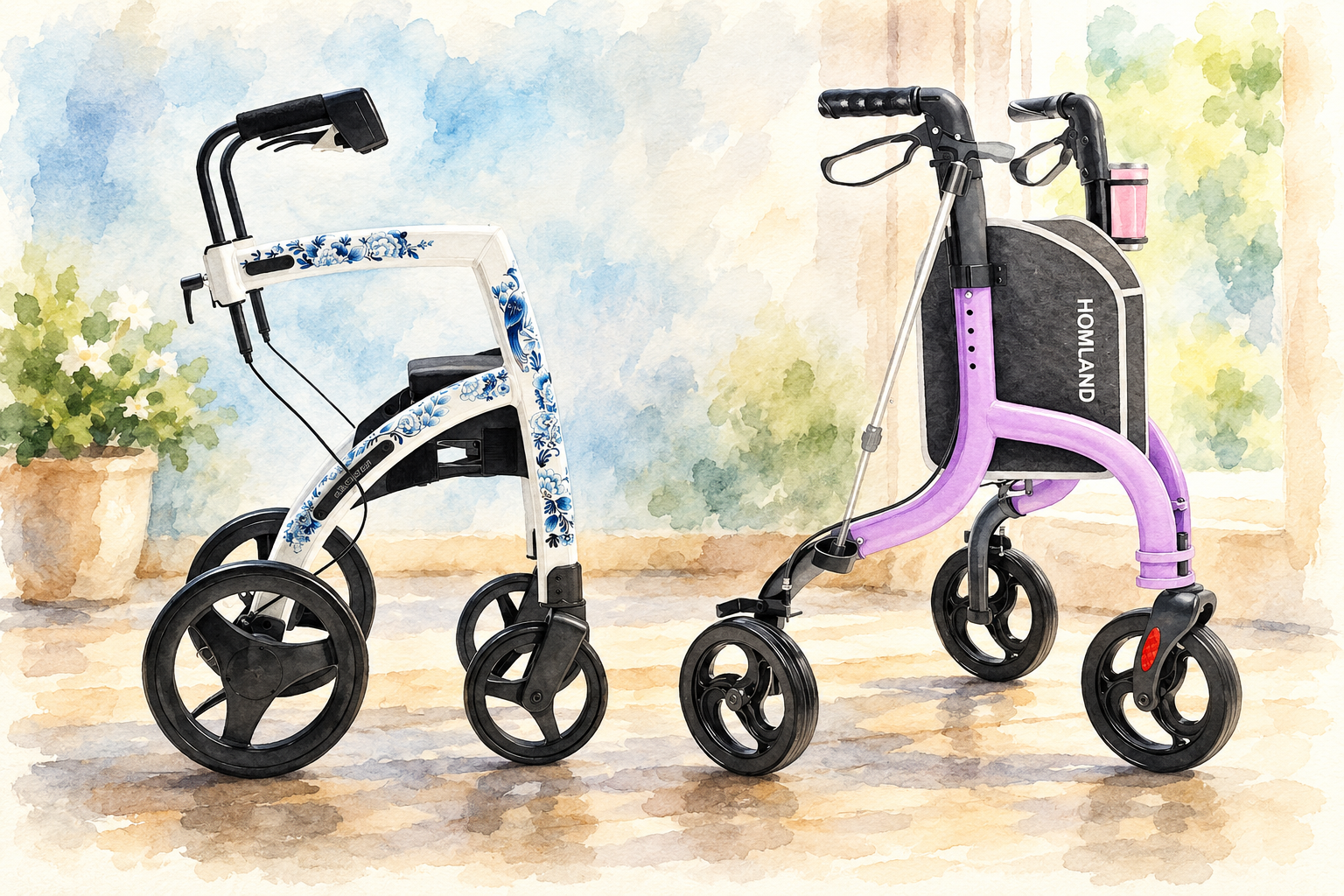
When it comes to 4-wheel walkers vs. 3-wheel walkers, the decision comes down to one trade-off: stability versus maneuverability. Both give you more mobility support than a standard walker, but they’re built for different situations, and picking the wrong one can mean less independence, not more.
Everything here is rooted in my experience caring for my dad, but a wider base and steadier support isn’t just a senior’s need — it’s for anyone recovering from surgery, managing a stroke or brain injury, or living with a condition that affects balance and strength, at any age.
My dad used a 4-wheel rollator for years before his hip fracture — when we’d visit the cemetery to spend a few minutes with mom, it gave him a seat to rest on, and enough stability that I didn’t have to hover over him on the uneven ground. A 3-wheel model would’ve been easier for him to turn in tight spaces, but he never needed that as much as he needed somewhere to sit down.
4-Wheel Walkers vs. 3-Wheel Walkers: The Quick Difference
A 4-wheel walker (rollator) has four wheels, hand brakes, a seat, and usually a storage basket. It’s built for stability and for people who need to stop and rest during a walk.
| Feature | 4-Wheel Walker (Rollator) | 3-Wheel Walker |
|---|---|---|
| Stability | Highest — widest base of support | Good, but less than 4-wheel |
| Maneuverability / turning radius | Wider turns needed | Tightest turns — best for narrow spaces |
| Seat | Yes, standard | Rare, most models skip it |
| Brakes | Hand brakes, standard | Hand brakes, standard |
| Weight | Heavier, 16–24 lbs | Lighter, 12–18 lbs |
| Best terrain | Outdoor, longer distances | Indoor, tight layouts, small homes |
| Storage basket | Usually included | Sometimes, smaller pouch style |
| Typical price range | $70–$150 | $60–$130 |
Who Should Choose a 4-Wheel Walker (Rollator)
If you need to rest partway through a walk, live somewhere with longer hallways or outdoor distances to cover, or want the extra stability of a wider base, the 4-wheel rollator is the safer bet. It’s the better choice for anyone with balance concerns significant enough that a narrower base feels risky.
Who Should Choose a 3-Wheel Walker
If you live in a smaller home, apartment, or anywhere with tight turns — bathrooms, narrow hallways, cluttered layouts — the 3-wheel’s smaller turning radius makes daily movement easier. It’s also lighter, which matters if you’re lifting it in and out of a car regularly.
According to the National Institute on Aging, a walker should be properly sized and have wheels that roll smoothly, since equipment that isn’t the right fit or condition raises fall risk rather than reducing it. That’s worth keeping in mind regardless of which wheel count you land on — fit and condition matter more than the spec sheet. National Institute on Aging

Frequently Asked Questions
Can a 3-wheel walker tip over more easily than a 4-wheel walker?
Yes, slightly. The narrower base means less side-to-side stability, though most 3-wheel walkers are still stable for normal indoor use. If balance is a significant concern, a 4-wheel model is the safer choice.
Do 3-wheel walkers come with a seat?
Rarely. Most 3-wheel designs skip the seat to keep the frame lighter and narrower, which is part of what makes them easier to maneuver.
Which is easier to fold and put in a car?
3-wheel walkers are generally lighter and fold into a smaller profile, making them easier to lift into a trunk or back seat.
Is a 4-wheel walker the same thing as a rollator?
Yes — “rollator” almost always refers to a 4-wheel walker with a seat and hand brakes.
Does Medicare cover both types?
Both are typically covered as durable medical equipment when prescribed by a doctor, though coverage details can vary. Check with your specific plan.

Final Thoughts
When you’re weighing 4-wheel walkers vs. 3-wheel walkers for yourself or a parent, there’s no universally “better” choice — it’s about matching the device to your space and your needs. If you’re weighing this decision for yourself or a parent, walk through your daily routes first: how far you go, how many tight corners you turn, whether you need somewhere to sit along the way.
Ron Anderson, Caregiver To My Dad, A WWII Veteran, For 6 Years
