
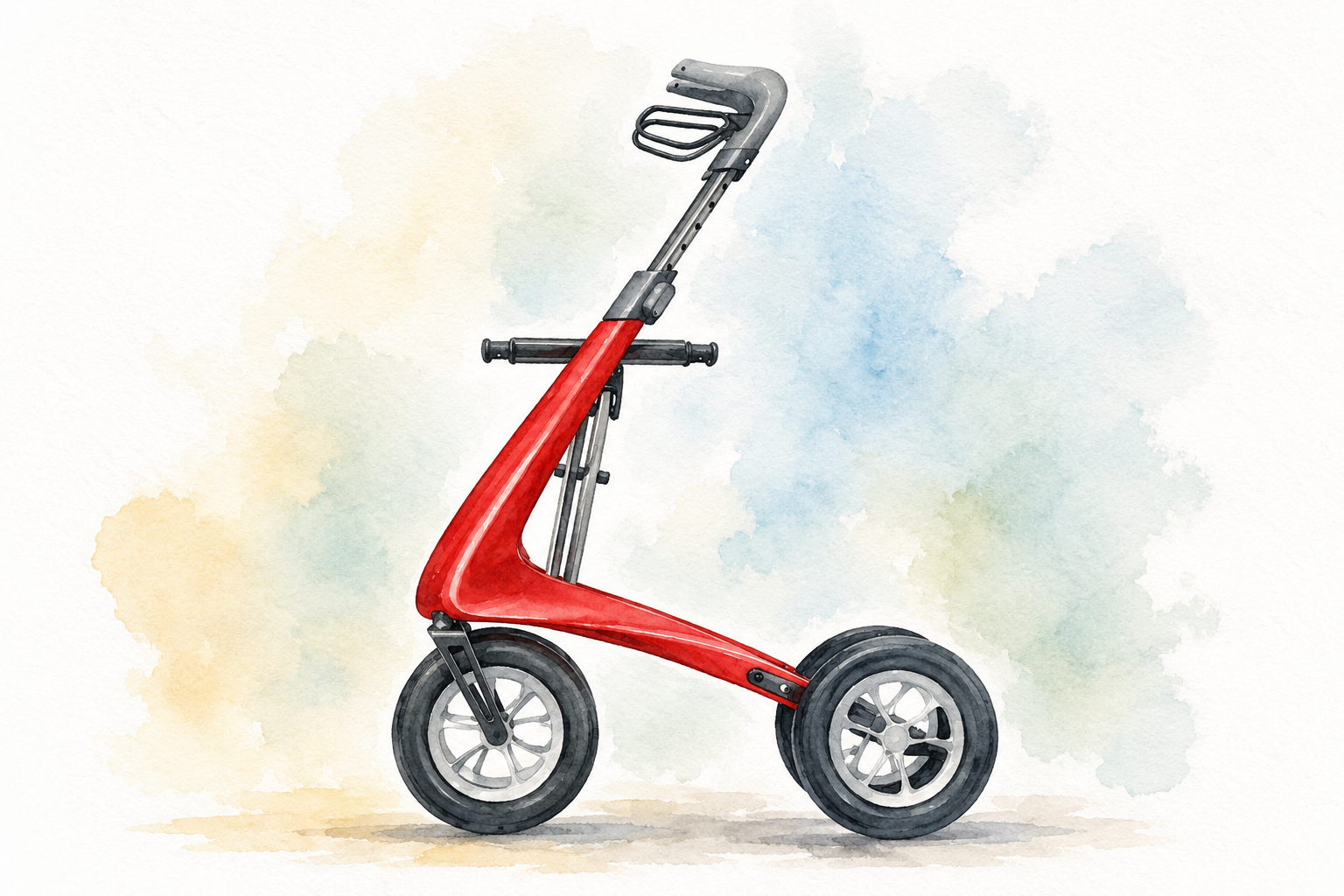
If you’re asking what is a 3 wheel walker, you’re probably looking for a mobility aid that’s easier to maneuver than a traditional walker but doesn’t feel as large as a four-wheel rollator.
A 3 wheel walker is a lightweight mobility aid built around a triangular frame — one wheel in front, two in back — designed for people who need extra support while walking but still want to move comfortably through narrow hallways, crowded stores, and smaller living spaces.
Unlike a standard walker, a 3 wheel walker has three wheels, hand brakes, and a lightweight frame that makes turning much easier. While it isn’t the right choice for everyone, it can be an excellent option for people with reasonably good balance who want additional stability and confidence while walking.
Let’s take a closer look at how these walkers work, who they’re designed for, and whether one might be the right fit for you.
You’ll also hear a 3-wheel walker referred to as a 3-wheel rollator. While the terms are often used interchangeably, they generally describe the same lightweight mobility aid with hand brakes and three wheels.
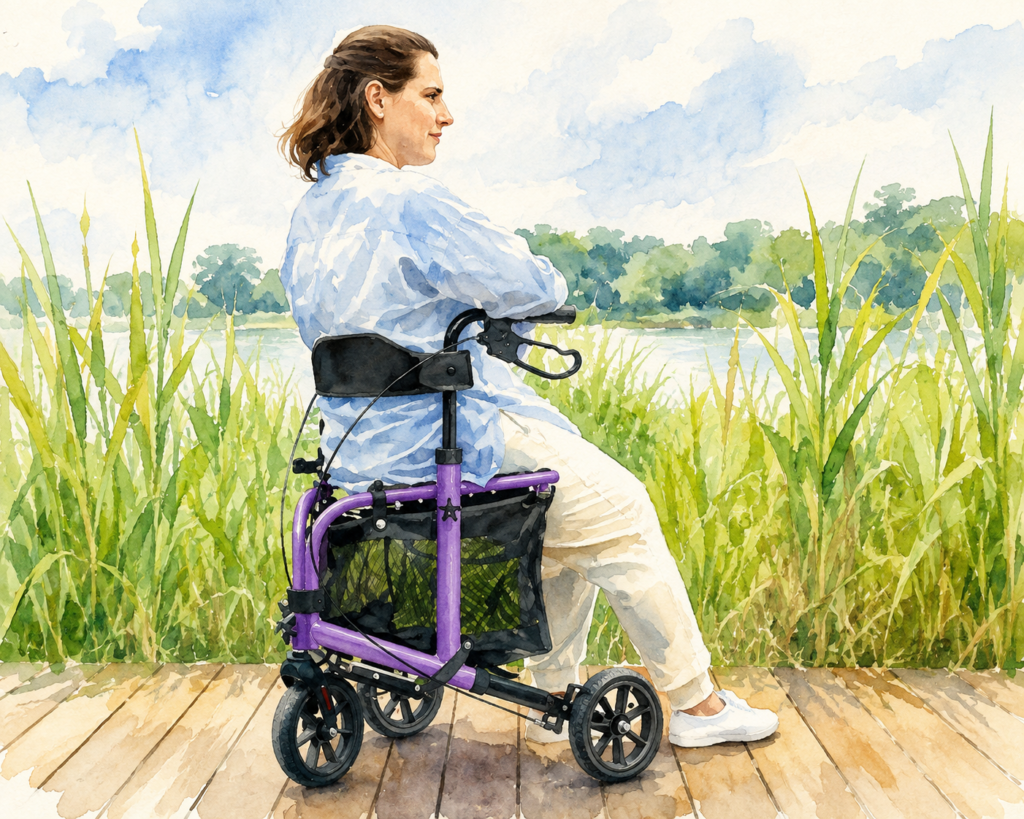
3-Wheel Walker at a Glance
| Feature | At a Glance |
|---|---|
| 👤 Best For | People with mild balance issues who want a lightweight mobility aid |
| ⚖️ Typical Weight | 11–16 pounds |
| 🛞 Wheels | Three (one front, two rear) |
| 🪑 Seat | Usually does not include a built-in seat |
| 🖐️ Brakes | Bicycle-style hand brakes with a locking feature |
| 🏡 Ideal Use | Indoor spaces, shopping, sidewalks, medical offices, and travel |
| ⚠️ Not Ideal For | People who need maximum stability, frequent rest breaks, or significant weight-bearing support |
What Is a 3 Wheel Walker?
To answer the question directly: a 3 wheel walker is a lightweight mobility aid with one wheel in front and two wheels in the back. Instead of lifting the walker with every step like a standard folding walker, you simply push it forward while walking.
Most models include:
- Three large wheels
- Ergonomic hand grips
- Bicycle-style hand brakes
- A storage basket or pouch
- Adjustable handle height
- A lightweight aluminum frame
Because there are only three wheels instead of four, the walker has a much tighter turning radius. That’s the core trade-off that defines this entire category — you give up some stability compared to a four-wheel rollator, but you gain the ability to move through tight spaces that a bulkier frame simply can’t handle well.

How Does a 3 Wheel Walker Work?
A 3 wheel walker rolls smoothly as you walk. Instead of lifting the walker off the ground with each step, you gently push it ahead while maintaining a comfortable walking pace. The hand brakes allow you to slow down, stop safely, or lock the wheels when standing still.
Many people find this much less tiring than constantly lifting a standard walker. The triangular frame also allows the front wheel to swivel freely, making sharp turns surprisingly easy — which is really the whole point of the design.
Key Advantages of a 3 Wheel Walker
If you’re still working out what is a 3 wheel walker actually good for, it comes down to three things:
- Tight turns. The triangular front design gives it a sharper turning angle, making it especially useful in narrow indoor hallways, small bathrooms, and tight rooms.
- Lightweight. Three-wheel frames weigh less than four-wheel rollators, which makes them easier to push, lift, and load into a car.
- Easy storage. They fold up more compactly than four-wheel models, which matters if you’re tight on closet space or traveling often.
Compared to a four-wheel rollator, the trade-offs run the other way:
- Stability. Four-wheel walkers have a broader, more balanced base of support.
- Seats. Four-wheel rollators almost always include a built-in seat for resting, while three-wheel walkers typically do not.
- Weight capacity. Four-wheel options generally support a wider range of user heights and weights.
| ✅ Pros | ❌ Cons |
|---|---|
| Lightweight and easy to lift into a vehicle | No built-in seat on most models |
| Excellent maneuverability in tight spaces | Less stable than a standard walker |
| Easy to navigate around furniture and narrow hallways | Not recommended for severe balance problems |
| Compact folding design for travel and storage | Smaller storage bag than most rollators |
| Ideal for shopping, errands, and everyday indoor use | Not designed to support full body weight |
When Does a 3 Wheel Walker Make the Most Sense?
A 3-wheel walker is often the best choice for people who are still fairly active but want extra support during everyday activities. Its compact design makes it especially useful in places where larger walkers can feel awkward or difficult to maneuver.
A 3-wheel walker may be a great fit if you:
- Live in a smaller home or apartment
- Frequently shop in grocery stores or retail stores
- Need to move through narrow hallways or doorways
- Travel often and want a walker that’s easy to fold and transport
- Want lightweight support without the added weight of a built-in seat
If you spend most of your time indoors or on smooth sidewalks, many people find that a 3-wheel walker offers an excellent balance between stability and maneuverability.
💡 Quick Answer A 3-wheel walker is best for people with reasonably good balance who want a lightweight walker for indoor use, shopping, travel, and smooth sidewalks. If you need to put significant weight on your walker or want a built-in seat for frequent rest breaks, a standard walker or 4-wheel rollator is usually a better choice.
Who Should Use a 3 Wheel Walker?
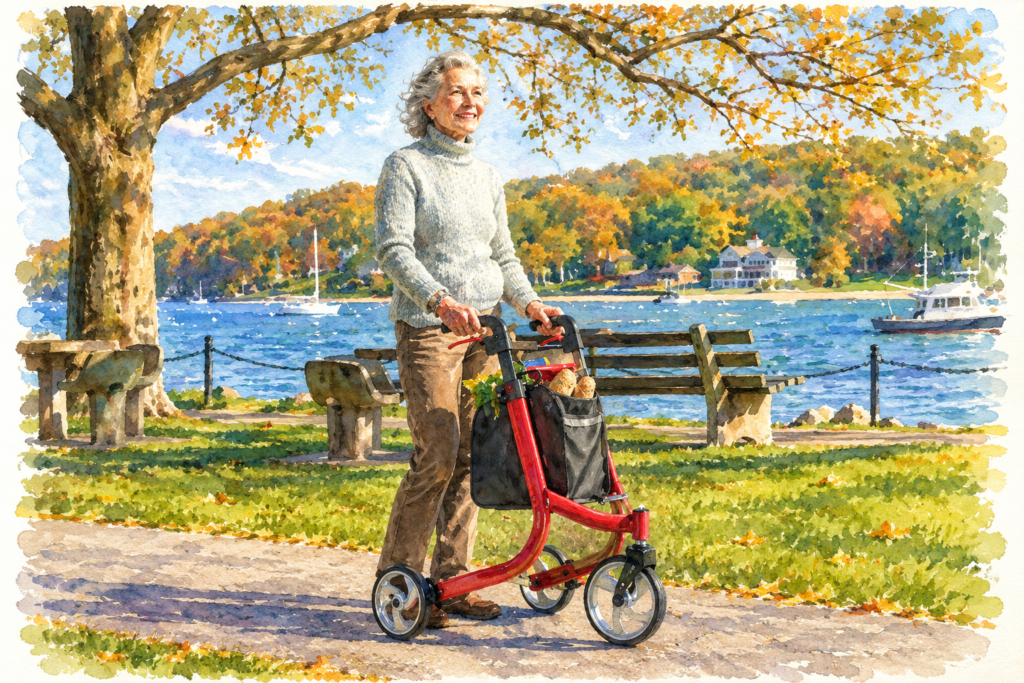
A 3 wheel walker works best for people who need moderate support but still have fairly good balance — this isn’t limited to any one age group. It fits anyone whose balance or strength has been affected, whether that’s from aging, arthritis, a recent surgery, or another condition that’s changed how steady they feel on their feet.
Good candidates often include:
- People who are generally active but tire more easily than they used to
- People recovering from minor surgery
- Individuals with mild arthritis or joint pain
- Those with slight balance issues
- Anyone wanting extra confidence while staying mobile
The goal isn’t to replace walking ability. It’s to make walking safer and more comfortable.
A Caregiver’s Perspective
💡My father never used a three-wheel walker. By the time he needed a rolling mobility aid, his balance had already declined to the point where he needed the stability and seat that only a four-wheel rollator could give him — that trade-off wasn’t a close call for us.
But I still think about the maneuverability question, because of one specific spot in our house: the bathroom. It was small, in an older home built long before doorways and bathrooms were designed with wide clearances in mind. Getting his four-wheel rollator turned and angled in that space was genuinely difficult — there just wasn’t enough room to work with.
That experience is exactly why I take the maneuverability advantage of a three-wheel walker seriously, even though it wasn’t the right tool for my father’s stage of need. If you’re earlier in that progression — good enough balance that you don’t yet need a seat, but living in an older home with tighter doorways and smaller rooms — that tighter turning radius isn’t a minor convenience. It’s the difference between a walker that fits your home and one that fights it.
Every person’s needs are different. A walker that works well for one individual may not be the safest choice for another, which is why it’s always worth taking the time to choose the right type of mobility aid.
Who Should Not Use a 3 Wheel Walker?
Although they’re convenient, they aren’t the safest option for everyone. A 3 wheel walker may not be appropriate if you:
- Have significant balance problems
- Put a large amount of weight on the walker
- Have frequent falls
- Need to lean heavily for support
- Have significant weakness on one side
- Need to sit frequently while walking
Because the frame has only three contact points with the ground, it generally provides less stability than a standard walker or a four-wheel rollator. If you’re unsure which type is right for you, ask your doctor or physical therapist before purchasing one.
3 Wheel Walker vs. Standard Walker
| Feature | 🟣 3 Wheel Walker | 🔵 Standard Walker |
|---|---|---|
| Wheels | Three | Usually two or none |
| Stability | ⭐⭐⭐ Moderate | ⭐⭐⭐⭐⭐ Excellent |
| Weight | ✅ Lightweight | ✅ Lightweight |
| Maneuverability | ⭐⭐⭐⭐⭐ Excellent | ⭐⭐⭐ Fair |
| Requires Lifting | ❌ No | ✅ Yes |
| Indoor Use | ⭐⭐⭐⭐⭐ Excellent | ⭐⭐⭐⭐ Good |
| Outdoor Use | ⭐⭐⭐⭐ Good | ⭐⭐⭐⭐ Good |
If maximum stability is your top priority, a standard walker usually wins. If easy movement is more important, a 3 wheel walker may be the better choice.
3 Wheel Walker vs. Rollator
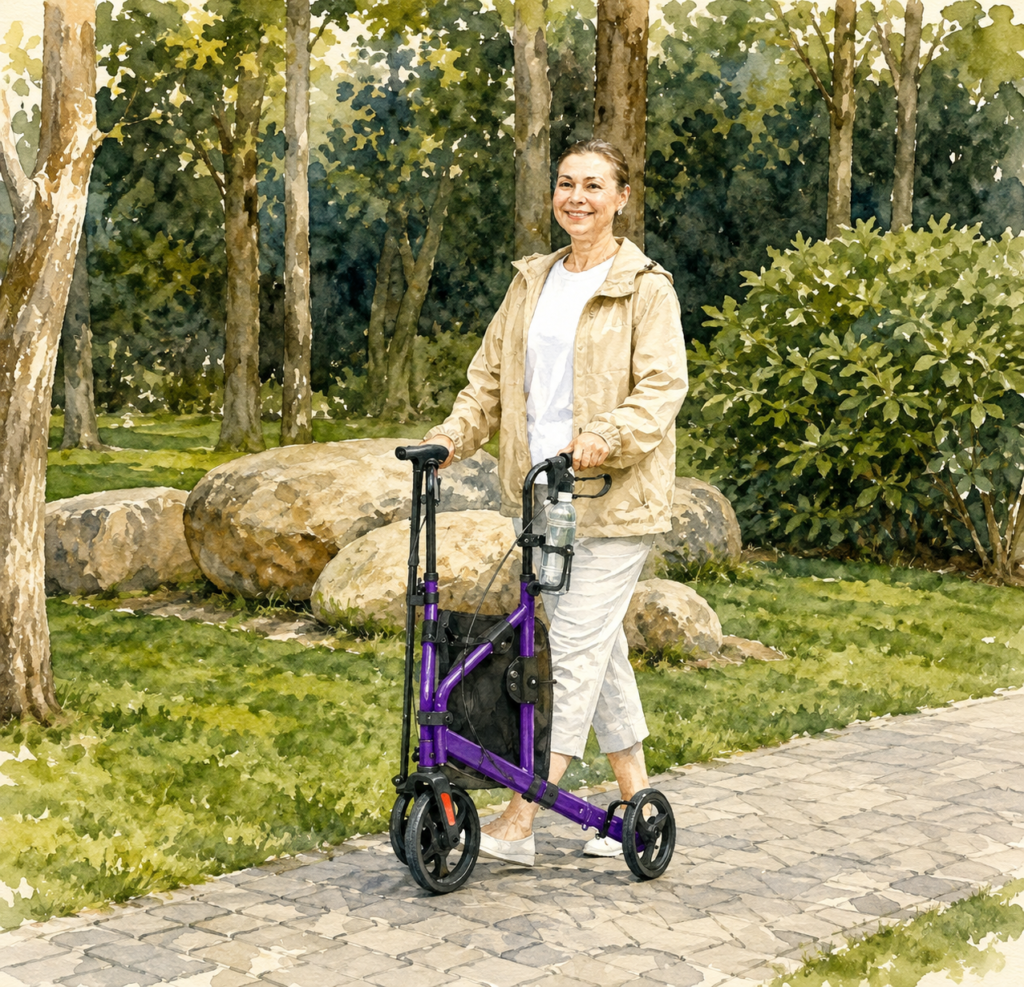
People often confuse these two mobility aids. Both roll smoothly, but there are important differences.
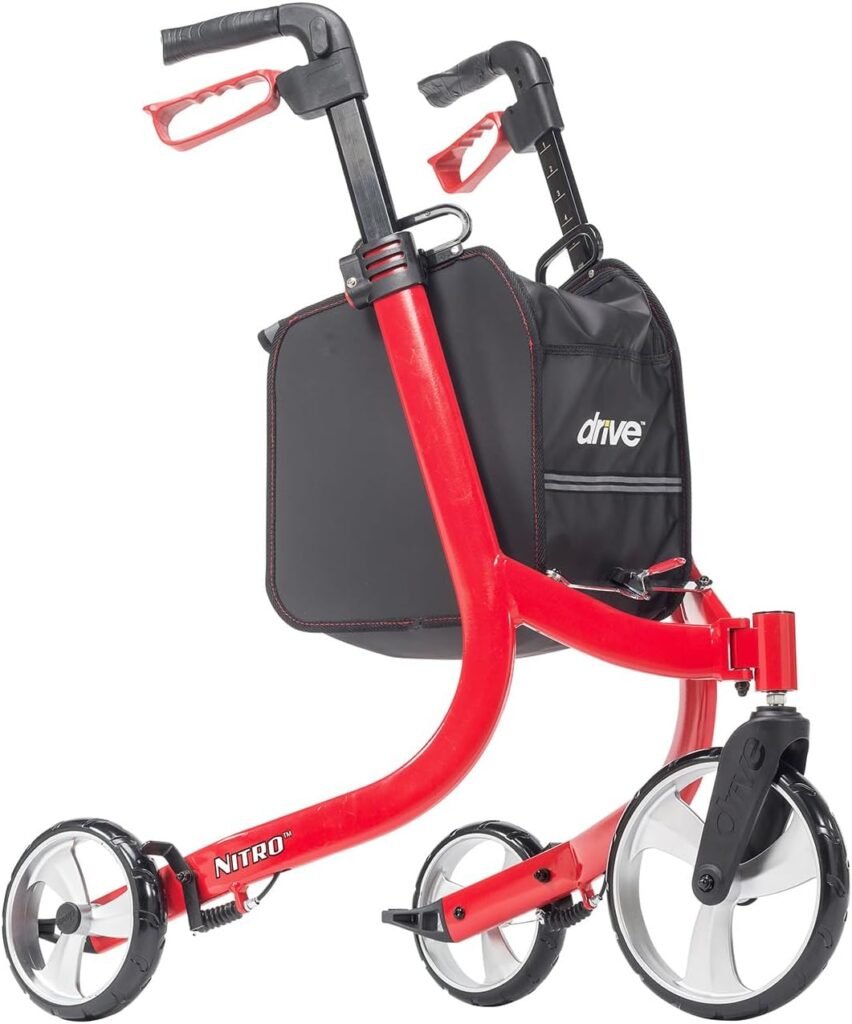
3 Wheel Walker
- Three wheels
- Smaller frame
- Lightweight
- Fits through narrow spaces
- No built-in seat on most models
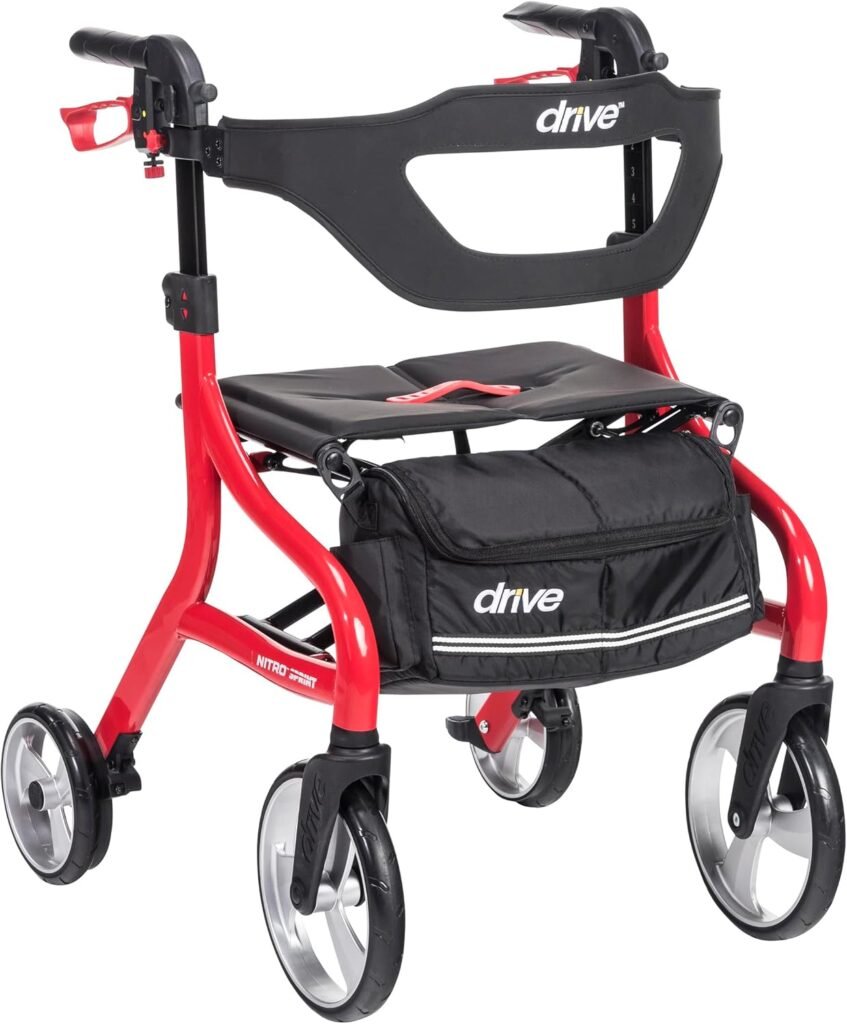
Four-Wheel Rollator
- Four wheels
- Built-in seat
- Larger storage area
- More stable
- Better for longer outings
If you often stop to rest during walks, a rollator with a seat is usually the better option. If you’re mainly walking indoors or need something compact, the 3-wheel design may be a better fit.
Is a 3 Wheel Walker Safe?
Yes — when it’s used correctly and by the right person. Some basic safety tips include:
- Adjust the handles to the correct height
- Walk inside the frame rather than behind it
- Use the brakes when standing still
- Avoid steep hills unless you’re comfortable controlling the brakes
- Never sit on the storage bag
- Don’t overload the basket with heavy items
Like any mobility aid, proper fit and correct use are just as important as the walker itself.
Can You Use a 3 Wheel Walker Outdoors?
Absolutely. Many people use them successfully on sidewalks, shopping centers, smooth pavement, indoor malls, medical offices, and community centers.
However, they aren’t ideal for rough terrain such as gravel, thick grass, sand, snow, or rocky trails. For uneven ground, a larger rollator with bigger wheels usually performs better.
Mobility Aid Progression
| Aid | Best For |
|---|---|
| 🚶 Standard Walker | Maximum stability and support |
| 🛞 2-Wheel Walker | More mobility while maintaining stability |
| 💜 3-Wheel Walker | Lightweight and highly maneuverable |
| 🪑 4-Wheel Rollator | Longer walks with a built-in seat and storage |
Keep in mind this is a general progression, not a fixed path everyone follows in order. Some people, like my father, skip a stage entirely depending on how quickly their balance and strength change.
How to Choose the Right 3 Wheel Walker
Not every model is built the same. Here’s what’s worth paying attention to.
Weight Capacity — Always choose a walker that supports your body weight comfortably. Many models support 250–300 pounds, with some heavy-duty versions supporting more.
Adjustable Handles — Proper handle height reduces strain on your shoulders, wrists, and back. Your elbows should remain slightly bent while holding the grips.
Easy Folding — If you’ll transport the walker often, choose one that folds quickly without requiring tools.
Comfortable Hand Grips — Soft ergonomic handles can make a surprising difference during longer walks, especially if you have arthritis or hand pain.
Reliable Brakes — Look for hand brakes that are easy to squeeze and lock securely, especially if you walk on slopes or uneven sidewalks.
Storage — A removable storage bag keeps everyday essentials close without forcing you to carry extra weight.

Common Mistakes to Avoid
Even a well-designed walker won’t help if it’s used incorrectly. Avoid these common mistakes:
- Buying a walker that’s too short or too tall
- Ignoring weight limits
- Forgetting to lock the brakes before stopping
- Carrying heavy grocery bags on the handles
- Walking too far behind the walker
- Using worn-out brake cables
Can Medicare Cover a 3 Wheel Walker?
Coverage depends on several factors. Under Medicare Part B, walkers may be covered as durable medical equipment (DME) when they’re considered medically necessary and prescribed by your healthcare provider.
However, not every 3-wheel walker qualifies for coverage. Some models may be considered upgraded convenience items rather than standard medical equipment, which could affect reimbursement.
Before purchasing a walker, it’s a good idea to:
- Talk with your doctor about whether a walker is medically necessary
- Confirm that your supplier accepts Medicare
- Verify whether the specific 3-wheel walker you’re considering qualifies for coverage
- Ask about any out-of-pocket costs before placing an order
Wondering if Medicare will pay for a rollator walker? Read our complete guide to understand Medicare coverage, eligibility requirements, and what to expect before you buy.
Recommended Options to Consider
- HOMLAND Foldable 3 Wheel Walkers
- Vive Mobility 3 Wheel Walker – Three Wheeled Rollator, Lightweight, Foldable
- Drive Medical Nitro 3 Wheel Rollator Walker
Quick Buying Checklist
Before purchasing a 3-wheel walker, ask yourself these questions:
- ✅ Does it support my weight?
- ✅ Are the handles adjustable to my height?
- ✅ Are the brakes easy for me to squeeze?
- ✅ Will it fit through my home’s doorways?
- ✅ Do I need a built-in seat, or is lightweight portability more important?
- ✅ Will I mostly use it indoors or outdoors?
How to Adjust a 3-Wheel Walker
A properly adjusted 3-wheel walker is safer, more comfortable, and easier to control. If the handles are too high or too low, you may end up leaning forward, straining your shoulders, or losing stability.
- Stand upright beside the walker. Wear the shoes you normally use for walking and let your arms hang naturally at your sides.
- Adjust the handle height. The hand grips should line up with the crease of your wrist when your arms are relaxed.
- Lock the adjustment pins or knobs. Make sure both handles are set to the same height and securely locked before using the walker.
- Check the brakes. Squeeze the hand brakes to make sure they engage properly and lock the wheels when needed.
- Take a short test walk. Your elbows should bend slightly — about 15 to 20 degrees — while holding the handles comfortably.
Safety Tip: If you find yourself leaning heavily on a 3-wheel walker or feel unsteady even after adjusting it correctly, it may be time to consider a more supportive mobility aid, such as a standard walker or a 4-wheel rollator.
For more infnformtion on adjusting your walker try my post How to Adjust a Walker to the Right Height
Final Thoughts
Understanding what is a 3 wheel walker is the first step toward choosing the right mobility aid for your needs. These walkers offer an excellent balance between support and maneuverability, making them a popular choice for people who want to stay active without the bulk of a larger rollator.
That said, no walker is perfect for everyone. If you need maximum stability or frequently need to sit and rest, another type of walker may be a better fit. But if you’re looking for a lightweight, easy-to-steer option that helps you move confidently through your home and community, a 3 wheel walker is certainly worth considering.
FAQ’s
Can a 3-wheel walker be used outdoors?
Yes. Most 3-wheel walkers can be used on sidewalks, paved paths, and smooth outdoor surfaces. However, rough terrain, gravel, uneven grass, or steep slopes can make them more difficult to control.
Do 3-wheel walkers have seats?
Most 3-wheel walkers do not include a seat. Their compact design focuses on maneuverability and lightweight portability rather than providing a place to rest.
Can I carry personal items on a 3-wheel walker?
Yes. Many models include a storage pouch, basket, or tray for carrying small personal items such as a wallet, phone, medications, or groceries.
What is the weight limit for a 3-wheel walker?
Weight limits vary by manufacturer, but many models support between 250 and 300 pounds. Always check the manufacturer’s specifications before purchasing.
Can a 3-wheel walker tip over?
Like any mobility aid, a 3-wheel walker can tip if it’s used incorrectly or on uneven ground. When used on smooth surfaces and by someone with good balance, it’s generally very safe. Always walk inside the frame, avoid leaning too far to one side, and use the hand brakes when standing still.
Is a 3-wheel walker better than a cane?
It depends on your needs. A cane provides minimal support and is best for mild balance issues. A 3-wheel walker offers greater stability, hand brakes, and storage while remaining lightweight and easy to maneuver. If you need more support than a cane provides but don’t require the stability of a standard walker, a 3-wheel walker may be a good choice.
