
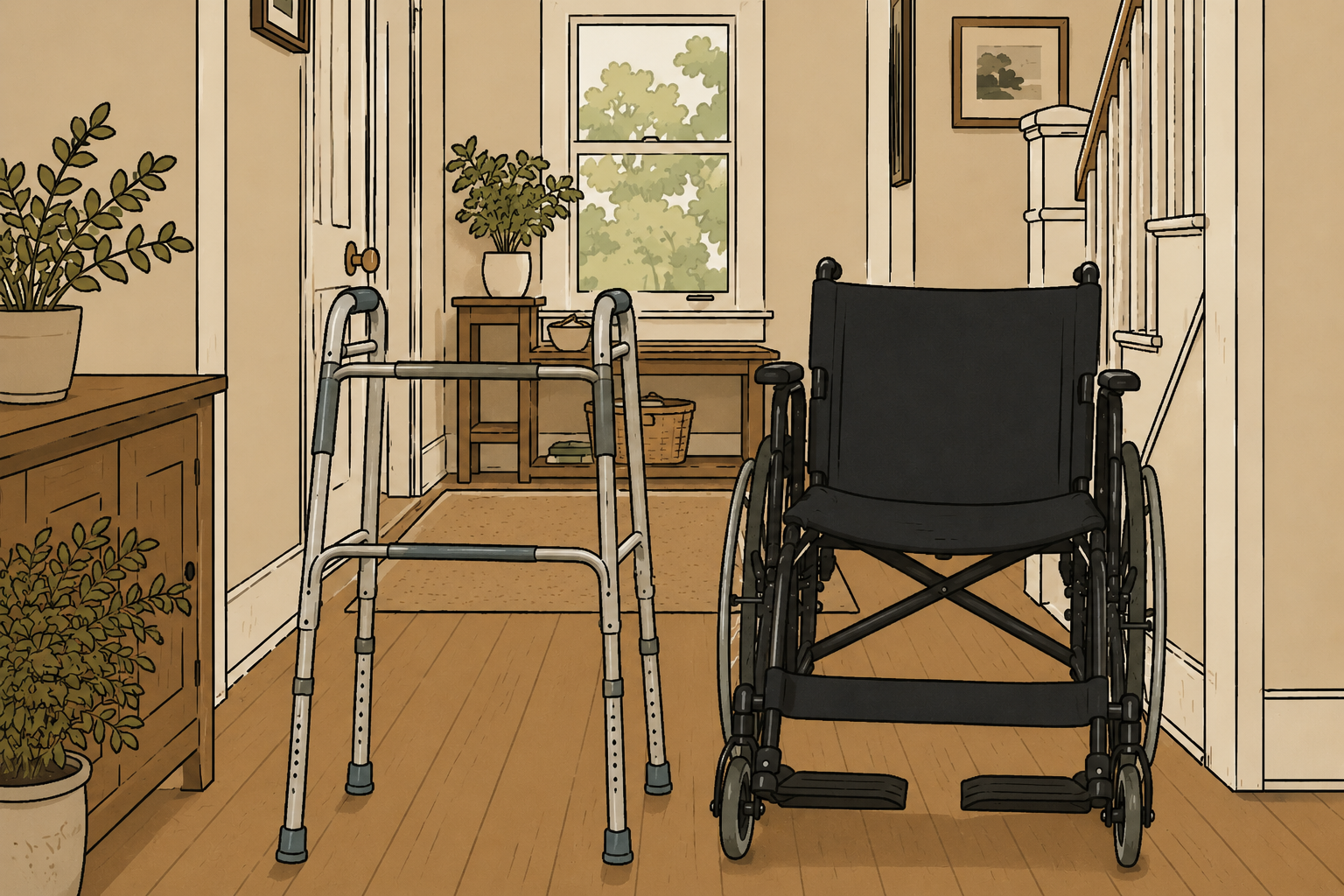
The walker vs. wheelchair decision doesn’t always happen all at once. For my dad, it came down to one afternoon with his physical therapist. The physical therapist came to the house twice a week. He would have my dad stand up, hold him from behind by his belt loop with a gait belt, and try to get him walking a few steps with the two-wheel walker they’d sent home from rehab.
He couldn’t do it on his own. His hip just didn’t have the strength anymore.
The wheelchair had already been decided before he even left rehab. They’d ordered it for him while he was still there. The walker wasn’t sent home as a way to avoid the wheelchair — it was sent home so the PT could work with whatever strength and mobility he had left. Those are two different things, and if you’re staring down this same decision for someone you love, that difference matters.
Quick Answer
If they can still bear their own weight, keep their balance with support, and haven’t started falling with the walker or cane they already have, a walker is likely still the right tool. If they’re falling even with an assistive device in use, can’t bear weight without someone physically holding them up, or their balance is gone entirely, it’s time to talk to their doctor about a wheelchair. Especially for someone living alone, safety should drive that decision faster than pride does.

Walker vs. Wheelchair at a Glance
| Factor | Walker | Wheelchair |
|---|---|---|
| Weight-bearing ability | Must be able to bear own weight | No independent weight-bearing needed |
| Balance required | Some balance needed, even with support | Balance not required for use |
| Supervision | Often independent, or supervised during recovery | Can be self-propelled or caregiver-assisted |
| Distance/endurance | Best for shorter distances, some stamina needed | Suited for longer distances, no stamina limit |
| Typical use case | Recovering strength, arthritis, general instability | Cannot bear weight, severe balance loss, post-fracture |
When a Walker Is Still the Right Choice
A walker works when someone has enough strength, balance, and endurance to bear their own weight and move themselves forward — they just need something to steady them or take pressure off a joint. That’s a wide range of situations: recovering from surgery, arthritis that makes standing painful, balance that’s become unreliable but is still there, or general fatigue that makes longer distances hard.
The test isn’t age. It’s function. Someone in their 70s with good hip and leg strength may do fine with a rollator for years. Someone recovering from a serious fall might need more support almost immediately, regardless of how active they were before.
Signs a Walker Isn’t Enough Anymore
A few honest signs that the conversation needs to shift toward a wheelchair:
- They can’t bear weight on one or both legs without someone physically holding them up
- Balance is gone even with a wide base of support like a walker provides
- They tire or lose stability before covering even a short distance
- A fall has caused an injury that limits weight-bearing capacity going forward
- The person using the walker no longer has the arm and core strength to control it safely
My dad hit several of these at once. He could technically move his legs with the gait belt support, but he had no balance left to do it without someone holding him up. That’s not a walker situation anymore — that’s a wheelchair situation, even if a walker is still part of the picture for supervised exercise.
If someone lives alone and keeps falling — off a cane, off a walker, off whatever they’re currently using — that repeated falling is itself the strongest signal, regardless of which device is involved. A fall risk that keeps repeating isn’t something to wait out or hope improves on its own. Talk to their doctor. A mobility evaluation can confirm what’s actually safe, and it also opens the door to insurance coverage for a wheelchair if it’s medically necessary.
The CDC’s STEADI program (Stopping Elderly Accidents, Deaths & Injuries) has a free set of caregiver resources built for exactly this moment — checklists and guides for recognizing fall risk before it turns into a hip fracture like my dad’s. It’s worth a look before that doctor’s appointment, just to walk in with a clearer picture of where things actually stand.

Our Story: From Cane, to Rollator, to Wheelchair
My dad’s mobility didn’t decline all at once. It moved in stages, and each device fit where he actually was at the time.
He started with a cane, on his own terms — nobody told him to use it, he decided he needed it and got one. From there he moved to a rollator, and he got real use out of it. It gave him independence for a good stretch of time; he was still out doing things, still moving around on his own.
Then he fell. He broke his hip, and it changed everything.
The doctors pinned his hip rather than replacing it. His doctor told us that if they’d replaced the hip instead of pinning it, Dad might have been able to use a walker instead of ending up in a wheelchair full-time. But that’s not the repair he got, and pinning wasn’t enough to give him back the strength and stability he needed to bear his own weight again.
He came home from rehab with a wheelchair already arranged and a two-wheel walker for the physical therapist to use during his visits. Twice a week, the therapist would stand him up, hold him steady by the gait belt, and have him try to walk. He could move his legs. He didn’t have the balance or the hip strength to do it without the therapist holding him up.
The wheelchair became his day-to-day reality. He hated it. Even though it was the right call, even though there wasn’t really another option left at that point, he never stopped wishing he could still walk on his own.
The Years After
He had that first wheelchair — a Drive model — for four or five years. It did its job, but eventually it needed repair, and getting a wheelchair repaired isn’t as simple as it should be. I ended up calling a guy who fixed bikes for a living, and he got it working again.
When it finally wore out for good, I called the VA. They came out to the house and had a wheelchair custom built for him. I never knew what it cost — they just took care of it. That’s worth knowing if you’re caring for a veteran: the VA can provide, and even custom-build, mobility equipment for a veteran who needs it, not just a standard model off a shelf.
He used that chair for the rest of his life. When he passed away, I left it at the VA home, so someone else who needed it could have it.
The Walker’s Role After a Hip Fracture
If you’re in this stage with someone you love, know that a walker sent home from rehab doesn’t necessarily mean a wheelchair is off the table — and it doesn’t necessarily mean it’s still in play, either. Often, like in our case, it’s simply a tool for physical therapy to maintain whatever strength and mobility remains, under direct supervision, while the bigger picture (a wheelchair, in our case) has already been decided based on the severity of the injury and the person’s ability to bear weight independently.
That’s a hard thing to sit with as a caregiver. It can feel like giving up on the walker too soon. It isn’t. It’s responding to what the body can actually do right now, while still using the walker for whatever benefit it offers in a supervised setting.

Wheelchairs Aren’t One-Size-Fits-All
“Wheelchair” covers more ground than most people expect, and knowing the difference can matter for a household weighing this decision.
- Transport chair — lightweight, foldable, pushed by a caregiver (no hand rims for self-propelling). Best for shorter outings, appointments, and trips out of the house rather than full-time in-home use.
- Standard manual wheelchair — self-propelled with hand rims, or caregiver-pushed. Requires enough upper body strength to self-propel, or a caregiver who can push it consistently and safely.
- Power wheelchair — battery-operated and user-controlled. Makes sense when someone has enough hand and arm function to operate the controls but not enough leg strength or stamina to walk or self-propel a manual chair.
For some households, a transport chair ends up being the actual middle ground between a walker and a full-time wheelchair — it solves the “can’t walk far enough safely” problem for outings and appointments without committing to full-time equipment at home.
What It Costs, and What Medicare Will Cover
Walkers are the cheaper option by a wide margin. A basic folding walker typically runs $30 to $100, and a rollator with a seat and hand brakes runs $70 to $300, depending on features.
Wheelchairs cost more across the board, and the range is wide depending on type: transport chairs typically run $150 to $500, standard manual wheelchairs $300 to $800, and power wheelchairs anywhere from $600 to $5,000 or more depending on features.
Medicare Part B can cover both walkers and wheelchairs as durable medical equipment when a doctor documents medical necessity. After the annual Part B deductible is met, Medicare typically pays 80% of the approved amount, with the remaining 20% the patient’s responsibility (or covered by supplemental insurance, where applicable). For a power wheelchair specifically, documentation usually has to show that a cane or walker can’t adequately meet the person’s mobility needs at home. The most reliable path is going through a doctor’s order rather than trying to sort coverage out directly with Medicare yourself.
For veterans, the VA is a separate avenue worth checking alongside Medicare — they can provide, and in some cases custom-build, mobility equipment for a veteran who qualifies.
Practical Logistics to Think Through
A few things that don’t show up in the cost comparison but matter just as much day to day:
- Doorway and hallway width. Standard wheelchairs need more clearance than a walker. Measure interior doorways before assuming a wheelchair will fit through them.
- Getting it in and out of a vehicle. Transport chairs and lightweight manual chairs fold down for a trunk. Power wheelchairs often need a ramp or lift, which is a bigger logistical and financial commitment.
- Who operates it day to day. A self-propelled manual chair needs the user’s own upper body strength. A caregiver-pushed model needs a caregiver who’s consistently available and physically able to push it. A power chair needs the user to safely operate the controls.
- Home layout. Turning radius in bathrooms and kitchens, thresholds between rooms, and stairs all factor in differently for a wheelchair than they did for a walker.

Final Thoughts
If you’re standing where I was — watching someone you love move from a cane, to a rollator, to a walker, and eventually to a wheelchair — none of those transitions mean failure. Each one just meets the body where it actually is, not where you wish it still were.
My dad hated his wheelchair. He never stopped wishing he could still walk on his own. But it also let him keep living — watching his games, staying in his own home, staying himself. That’s worth holding onto when the decision feels like giving something up. It isn’t. It’s what lets life keep going.
Want me to check the live URL to confirm it actually made it into Elementor, or were you thinking of a different post?
Frequently Asked Questions
Can someone use a walker and a wheelchair at the same time?
Yes. It’s common for a walker to be used for short, supervised distances or physical therapy exercises while a wheelchair handles daily mobility. They aren’t always either/or.
What determines whether someone can recover walking ability after a hip fracture?
Several factors play in: the type of fracture, whether the hip was pinned or replaced, the person’s strength and balance before the injury, and how much muscle mass and stability they’re able to rebuild during rehab. Age alone isn’t the deciding factor — overall function is.
Is it giving up to move to a wheelchair if a walker was tried first?
No. A wheelchair isn’t a failure — it’s the right equipment for where someone’s body actually is. Trying a walker first, under supervision, is often part of finding that out safely.
Does insurance or Medicare cover both a walker and a wheelchair?
Coverage depends on medical necessity as documented by a doctor. It’s possible to have both covered if each serves a distinct, documented purpose in a person’s care plan — see the cost and coverage section above for how that process typically works.
Is a transport chair a good middle ground between a walker and a wheelchair?
For some people, yes. A transport chair handles the “can’t walk far enough safely” problem for outings and appointments without committing to full-time wheelchair equipment at home. It’s worth asking a doctor whether that’s a fit before assuming it’s a walker-or-wheelchair choice.
