
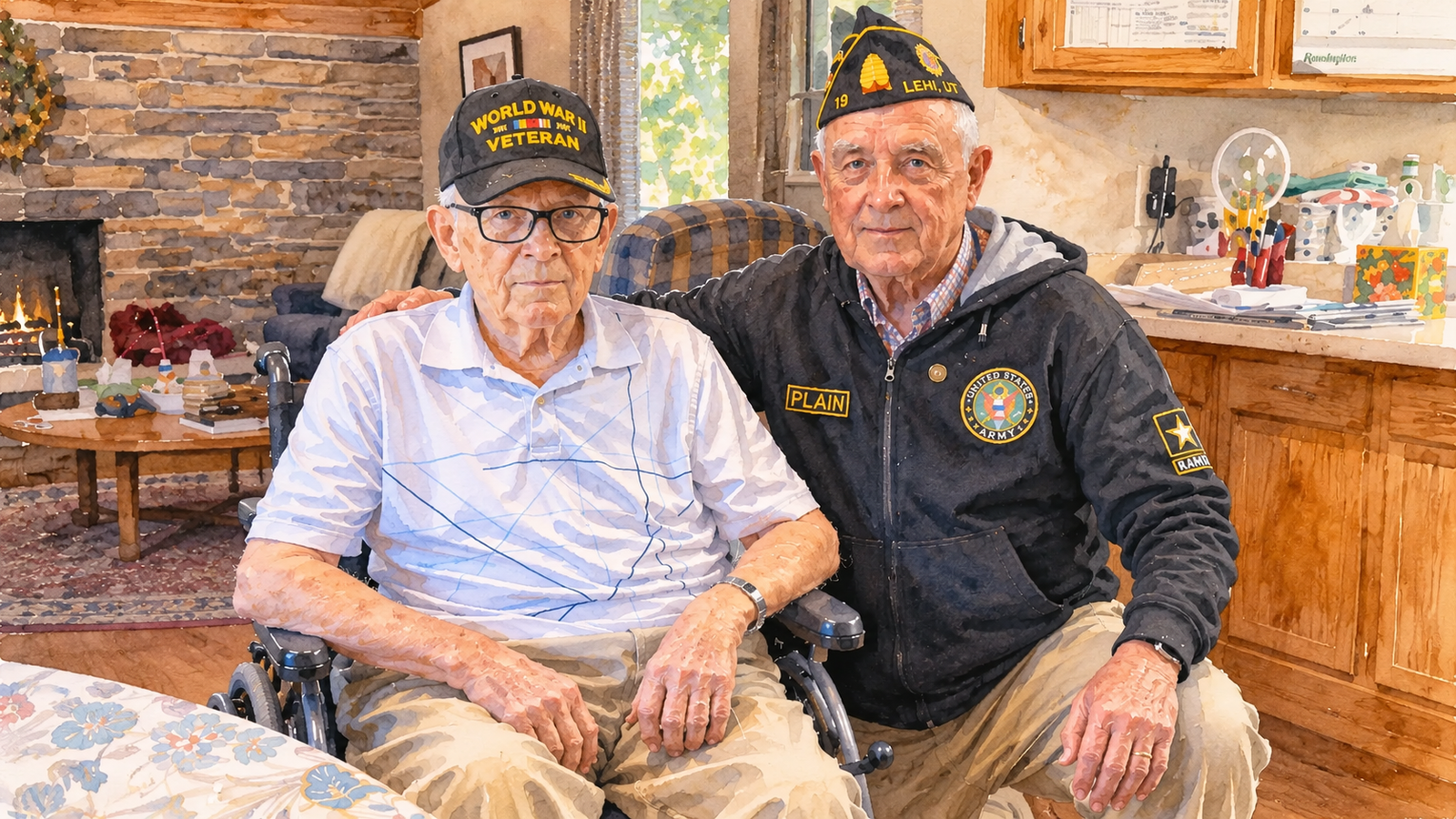
For six years I was the full-time caregiver for my dad, a WWII veteran. For a big part of that time, we had the VA in our corner through its VA caregiver program. People ask me what it was like, and whether it’s worth the hassle of signing up. My honest answer: getting in takes some work, but once you’re in, it’s worth it. Here’s what our experience looked like, start to finish, the good and the hard.
The VA also wrote about my dad and me. You can read that story here: Love and Duty Guided Me to Be His Caregiver.

How It Started: After Dad Broke His Hip
My dad wasn’t in the VA system for most of his life. That changed after he fell and broke his hip. While he was finishing rehab, I made him go up to the VA and get enrolled. H e was in his late nineties, and I knew things were only going to get harder from there. I wanted every bit of help available to him.
Getting Into the VA System Isn’t Easy
I’ll be straight with you: enrolling isn’t the easiest thing in the world. For my dad, it took three or four appointments before he was officially in the system. First there was an initial visit with a VA doctor. After that, there was a cognitive test, where they went through some questions and tasks with him, and I believe a hearing test too.
The biggest hurdle was his military records. Some of his World War II records had gone missing, and for a while we didn’t know if they’d turn up. Eventually the VA found them, and after that things moved forward.
But once you’re in, you’re in. After that, things got much easier.
What Is the VA Caregiver Program?
The official name is the Program of Comprehensive Assistance for Family Caregivers, or PCAFC. It’s part of the VA’s Caregiver Support Program, and every VA medical center offers it. You can read the VA’s full details on their PCAFC page.
Who qualifies (the short version):
- The veteran needs a service-connected disability rating of 70% or higher, and needs hands-on personal care for at least six months in a row. My dad was rated 100%, so he met that part.
- The caregiver has to be at least 18, be a family member or live with the veteran full-time, complete the VA’s caregiver training, and take part in a home assessment with the veteran.
How you apply: The veteran and caregiver fill out and sign a joint application, VA Form 10-10CG, which can be done online. After that, someone from the local Caregiver Support team reaches out to go over eligibility and walk you through the evaluation.
What caregivers can get: Support groups, peer support, respite care, and mental health counseling. The main (primary) caregiver can also qualify for a monthly stipend and, in some cases, health coverage through CHAMPVA.
What to expect once you’re in: The VA does regular check-ins called wellness contacts, usually about every four months, with a yearly visit to the veteran’s home. For us, most of those happened by phone because of COVID, and they never felt like a burden. It was more like someone making sure we were both okay.
What the Application and Interview Process Looks Like
The VA lays out the process in ten steps. Here’s the plain-English version:
- Apply. The veteran and caregiver fill out VA Form 10-10CG together, online or on paper. The VA can help you fill it out.
- Intake. Someone from your local Caregiver Support team goes over the application with you, in person, by phone, or by video.
- Veteran assessment. A clinical assessment of the veteran’s needs, with input from you as the caregiver.
- Functional assessment. A closer look at what the veteran can and can’t do on their own.
- Caregiver assessment. An assessment of you, the caregiver.
- Initial review. A VA team reviews the assessments and medical records.
- Caregiver training. You complete the VA’s caregiver training, online or with a workbook.
- Home visit. An assessor comes to the veteran’s home to see how you’re both doing and make sure you can provide the care he needs.
- Final review. The VA makes its decision.
- Notification. Within 90 days of receiving your application, the VA calls to tell you the result and mails an official letter.
What they’ll ask about: expect questions about how much help the veteran needs with everyday things like eating, bathing, dressing, grooming, using the bathroom, and getting around, plus whether he’s safe to be left alone.
My biggest tip: give them the full, honest picture, including the bad days. Caregivers tend to downplay what they do because it’s become routine. The VA can only approve what they understand, so tell them everything you really do.

Becoming His Caregiver Through the VA
To be approved as Dad’s caregiver, I had to complete the VA’s caregiver training. Mine was online. You read through the material and then answer questions about it. It took me about an hour, and honestly, most of it was common sense.
That’s not a knock on the VA. Nobody can really teach you how to be a caregiver. It’s like going to business school: until you actually start running a business, you don’t know much. You can take all the caregiver courses you want, but you don’t get the real experience until you’re doing it every day.
Before I was approved, the VA came out to the house for a home assessment. I had to show them how I transferred Dad, moving him safely from one spot to another. I also walked them through his bathroom and showed them everything we had set up: his toilet safety rail, his raised toilet seat, the tall vertical transfer pole in front of his shower, and the bed alarm that let me know if he was trying to get up at night.
It wasn’t a test designed to trip you up. They just wanted to see that Dad was safe at home and that I could actually do the hands-on care he needed.
When I applied, Dad still had a CNA coming to the house three days a week. She bathed and dressed him on those days. We didn’t pay for her out of pocket. Medicare covered her visits for a while, and later the VA picked it up. Everything else was up to me. On the other days I helped him dress and get ready, and every day, anything else that had to do with Dad’s life, I handled. Having some outside help didn’t change the fact that I was his main caregiver, and I’d tell anyone in the same situation to be clear about that split when they talk to the VA.
I got approved, and about a year later COVID hit. That changed how things worked. For most of our time in the program, a VA nurse named Lori Davis checked in with me by phone, about every three months. She’d ask how Dad was doing, how I was holding up, and whether we needed anything. If I had a problem between calls, I could call her, and she always called me back.
Toward the end, Lori came out to the house a couple of times. The visits were short, maybe 15 minutes, just to see how everything was going.
What the VA Did for Dad
My dad was rated 100% disabled by the VA. Anything the VA could do for him, they did.
Because the main VA hospital was far from us, and Dad was in a wheelchair and in his late nineties, the VA let him keep seeing his own private doctor. We only had to go to the local VA clinic once a year for a checkup, so they could update his files.
The one big thing I asked the VA for was a new wheelchair for Dad, a couple of years before he passed. The VA ordered it, and a man from the wheelchair company came out to the house to measure him.
Dad’s house was built in 1975, and back then doorways weren’t made very wide. So his chair had to be narrower than a standard wheelchair to fit through the doors. Honestly, Dad didn’t like it much at first. It was smaller than he was used to and a little heavier. But let me tell you, it was top of the line. This wasn’t something you’d buy off Amazon. It was heavy duty, it was measured just for him, and it fit him perfectly.
The VA also sent out a ROHO air cushion for the seat. Those aren’t cheap. The one he got would cost around $800 if you bought it online.
When Dad passed away at the VA home in Payson, I donated the wheelchair to them so someone else could use it. It was still in great condition, and it felt right that it would keep helping another veteran.
How Much Does a VA Caregiver Get Paid?
This is the question people ask me most. As my dad’s primary family caregiver, I received a monthly stipend of about $1,600 to $1,700. It wasn’t a lot of money for round-the-clock care, but it helped, and I was grateful for it.
A lot of people assume the stipend comes out of the veteran’s own VA payment. It doesn’t. My dad kept his full benefit, and my stipend was paid to me separately.
The VA figures the stipend from a federal pay scale based on where the veteran lives, and it comes in two levels depending on how much care the veteran needs. That means your amount could be quite different from mine. The VA’s stipend page explains how it’s calculated, and your local Caregiver Support team can tell you what to expect.
If You Get Turned Down, Don’t Give Up
Before I was approved for the caregiver program, I actually applied for another VA program to help pay for Dad’s care, and I got turned down. It’s been a few years, and I honestly can’t remember now which program that first one was.
What I do remember is the interview. They asked questions about caregiving tasks the way a CNA would talk about them, and I’d never been a CNA or a professional caregiver. I was just a son taking care of his dad. I didn’t know how to answer, so I didn’t do a good job of explaining everything I was really doing for him every day.
Then I applied for the caregiver program and got approved.
If I could go back, here’s what I’d tell myself:
- Write down what you actually do before any interview. Helping them bathe, dress, use the bathroom, get in and out of bed or a wheelchair, take medications, and staying with them because they can’t be left alone. We do so much of this on autopilot that it’s easy to forget when someone asks.
- Use plain words. You don’t need to know the medical terms. “I help him get from the bed to the wheelchair every morning” tells them what they need to know.
- Ask for help with the application. Your local VA Caregiver Support team can explain what they’re looking for before your evaluation.
- A “no” from one program isn’t a “no” from all of them. The VA has more than one way to help caregivers, and your state may have options too. If one doesn’t work out, ask what else you might qualify for.
The Part No Program Can Fix
I want to be honest here, because I’m not going to whitewash it. The VA helped, and I’m grateful. But no program changes the math of caregiving.
The CNA came three days a week, about an hour each time. That’s three hours out of 168 in a week. The rest was me. For five years, I was with my dad 24/7.
A lot of it was good. There were some great times with Dad. I used to tell people 90% of it was good, but as time wore on, that changed. If I’m honest, it was closer to 60% good and 40% pretty bad.
Nights were the hardest. Dad would get confused and not know where he was, and it was frightening, for him and for me. For about two and a half years, I slept on an air mattress on his bedroom floor so I’d be right there if he had a spell. Some nights I lay on top of his bed with a blanket over me, just so he could feel me next to him. It comforted him. But it was scary, and some of it was traumatizing.
I felt alone a lot of the time. Lori’s calls helped, and knowing I could reach her helped. But at 2 a.m., it was just me and Dad.
If you’re a caregiver and you feel that way too, you’re not doing it wrong. Caregiving is hard, and it’s okay to say so.
Was the VA Caregiver Program Worth It?
For us, yes. The program did what it was supposed to do. It paid me something for the work, it gave Dad a chair made for him, and it gave me someone to call. It didn’t make caregiving easy. Nothing does. But it made it possible.
My Advice If You’re Just Starting
- Push through the enrollment process. It’s frustrating, but it’s the hard part. Everything after is easier.
- Get enrolled sooner rather than later. Don’t wait for a crisis. We waited until after Dad’s hip fracture, and I wish we’d started earlier.
- Don’t panic if military records are missing. Many older records were lost or damaged over the years, including in a major 1973 fire at the National Personnel Records Center in St. Louis. Ask the VA to help track them down or rebuild them from other documents. Dad’s took a while, but they turned up.
- Practice your transfers before the home visit. They’ll likely ask to see how you move your veteran, from bed to wheelchair or onto the toilet. Do it the way you normally do, safely and calmly.
- Ask about keeping your own doctor. If the nearest VA hospital is far away, ask whether your veteran can keep seeing their own doctor.
- Ask for what you need. The VA can’t help with what they don’t know about. When Dad needed a new wheelchair, all I had to do was ask.
- Get to know your nurse or coordinator. Having one person who knew us made everything easier.
What I’d Tell Someone Thinking About Doing This
Do it. But be prepared, because it’s not the easiest thing in the world.
Here’s how I put it. Your parents raise you, but you don’t really get to know them. You’re their kid, and at 18 or 20 you move out and start your own life. Caring for my dad, I got to know him in a way I never had. I learned his fears. I learned what made him happy.
But it’s also like having a roommate, and that roommate is your father, or your mother, or your grandmother. There were plenty of times I wanted to throw in the towel. More than once I told him, “I’m done. I can’t do this anymore.” And he’d cry. And I’d keep going. Honestly, I don’t know how I did it. I guess I just did it.
If you take this on, know that wanting to quit doesn’t mean you’re doing it wrong. It means you’re human.

The Last Six Weeks
I’ll end with the part that’s hardest for me to write.
In the last six weeks of Dad’s life, he went into the hospital for 10 days, and then to a rehab facility that didn’t help him. By then I was completely burned out. I told him, “Dad, I just can’t do it anymore.”
He was accepted into the VA home in Payson, which, let me tell you, is incredible. I told him, “Let’s try it for two weeks. If you don’t like it after two weeks, I’ll bring you home.”
He was there 14 days. He caught another viral infection in his lungs, RSV. His doctor at the hospital had already told me that if he got another one, it would take him. And it did. He also had heart disease and kidney failure. He wasn’t in good shape, and the fact that he lived to 102 was amazing.
His doctor told me that I was the reason he lived those extra five or six years, because I took care of him. Dr. Francis called me Dad’s hero.
I still feel guilty about those last six weeks. Part of me thinks I should have kept him at home. But I was done, and I’m glad it was six weeks and not two years. If you’re a caregiver carrying that same kind of guilt, I understand. I’m still working through mine.
This article is based on my own experience as a family caregiver. VA programs and eligibility rules change, so check the VA’s caregiver program page or talk to a VA Caregiver Support coordinator for current details.
