

When people picture a family caregiver, they usually picture a daughter or a wife. That’s not wrong. About three in five family caregivers are women. But that means roughly two in five are male caregivers, and a lot of us don’t even use the word. We just say we’re “helping Dad out.”
I was one of those guys. I took care of my father, a WWII veteran, for six years, the last five of them around the clock, until he passed in 2023. This is what it was actually like.

How It Started
I’d always been the one around. I worked with Dad in the cabinet business, and the office was in the basement of their house. After work, I’d mow the lawn, help Mom in the garden, and do whatever Dad needed done.
Mom and Dad were together for 65 years. When she died, he was lonely. I spent the weekends with him for six months. I’d sleep over, help him through the day, and drive back to work.
Even after I went back to Salt Lake, I called him every night when I got home from work. He hated being alone. He told me the nights were the worst, and I believe it.
“You’re the Only One I Can Count On”
Dad was 95 or 96 when he broke his hip. There was a lot going on in the background then, mostly family stuff I won’t get into. It still makes me sick to think about.
To get out of rehab, he had to learn to transfer in and out of his wheelchair and dress himself. “I’m going home,” he told me. “I’m going to try like hell to get out of here.”
I’d come down and we’d sit and talk about what was going on and how he was feeling. Then one day, just in passing, he looked me right in the eye and said, “You’re the only one I can count on.”
Dad knew his family. He knew exactly who each person was and what he could expect from them. But I only realized how true that was the other day. The family visited him in rehab, but after he got home, they hardly ever came around, and they didn’t help.
He did make it home, just like he said he would. He was in a wheelchair, and he lived by himself for close to a year and a half. A CNA came three days a week. The rest was up to him.
Every morning, he got out the pan and made his eggs, toast, and a little bacon. Here was a man in his mid-90s learning a whole new way of life. I guess if you have to, you have to. But that’s pretty goddamn impressive.

“That Would Be Ideal”
During that time, his neighbors were the ones looking in on him. Not family. Neighbors. They brought him dinner every other night, took him to the grocery store, and came by at night to check on him. There was always somebody at his house.
If he wasn’t answering the phone, I could call one of them to go find him. It was never anything. He was just out doing something. Knowing they were there was a comfort to my heart.
My brother told me one day that the neighbors couldn’t keep taking care of Dad. He was right, but he didn’t offer a solution.
Dad never asked me to move in. He and Eric, the neighbor down the street, talked about a lot of things, and in one of those conversations, Dad said it would be nice if I did. Eric passed it along. “Your dad wants you to move in with him,” he told me. “Why don’t you think about it?”
Dad never said a word about it to me. So one Sunday, driving home from the cemetery, I finally asked him. “I heard you want me to move in with you.”
“That would be ideal,” he said.
That’s all he said. One thing about my dad: he asked you once, and he never asked again.
It took me eight months to decide. Almost everyone I talked to, friends and coworkers, told me not to do it. Only Eric told me I should. He even kidded me about it once: “Oh, come on, move in with your dad.”
It was a hard decision, and I’m still not sure why. I hated moving, and maybe part of it was ending up back in my parents’ house. I had no idea what I was getting into.
I did it anyway.
I called Dad and said, “I’m all packed. I’ll be out Sunday.” It was around the first of April. The movers had me out in two hours, and I was in Lehi by 12 o’clock.
What a lesson, let me tell you.
The Promises I Broke
When I moved in, I made myself some promises. I didn’t want to see my dad naked. I wasn’t going to be the one handling the bathroom stuff.
I ended up doing all of it.
It started with the shower. Some days he wasn’t strong enough to get in and out on his own, so I helped him. The first time was awkward for both of us. After that, it was just part of the routine.
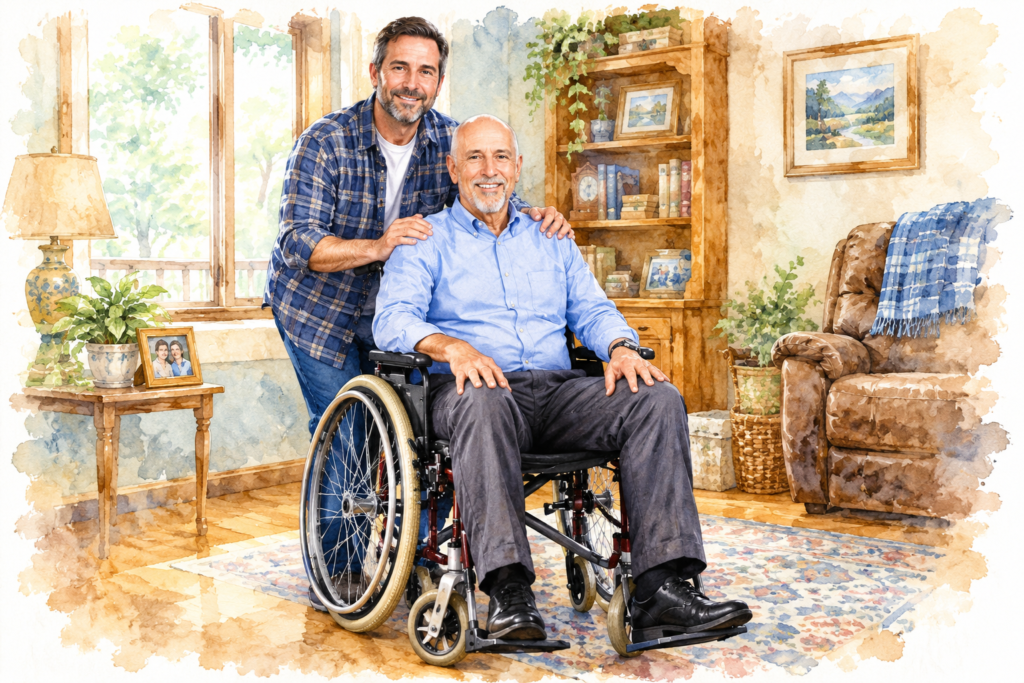
Nights were harder. For about two and a half years, I slept on an air mattress on his bedroom floor, and sometimes on top of his bed under a blanket, so I could be close. He’d get confused at night and not know where he was, and that frightened me.
We tried a handheld urinal at the bedside, but half the time he’d miss and it would end up on the floor. So when he woke up needing to go, I’d get him up, pull down his pajamas and underwear, sit him on the toilet, help him back up, and pull everything back up again. Middle of the night, half asleep, every time.
Toward the end, he couldn’t clean himself after a bowel movement anymore. So I did it.
When it actually came time, I didn’t give it a second thought. Every promise I’d made to myself went out the window, and I never regretted breaking them. It was my dad, and he needed help.
If you’re a guy just starting out as a caregiver and you’re drawing those same lines in your head, I get it. I drew them too. But you’ll probably cross every one of them, and when you do, it won’t feel like a big deal. It’ll feel like taking care of your father.
Did People Treat Me Differently?
People ask if I got treated differently as a man doing this. Honestly, not that I noticed, at least not to my face. Maybe some people were a little surprised, but nobody made an issue of it.
The hardest part wasn’t how people treated me once I was caregiving. It was getting there, with nearly everyone telling me not to.
So if you’re a guy on the fence, the pushback you’re worried about might not come from nurses or strangers. It might come from the people around you, and from inside your own head. Once I was in it, nobody questioned whether a son could do this job. I was just doing it.

What I Gave Up
For the first year, I was still working up in Salt Lake while taking care of Dad. It was too much. Too stressful. After that, it was 24/7 for five years.
In those five years, I can remember exactly one break. Someone came over and sat with Dad for two and a half hours. I ran up to the store and got a hamburger. That was it.
I gave up my social life. I gave up my life, really. Every single thing, I gave up for my dad.
And I had no help from my family. Not one of them ever asked if I needed a break. Not once.
I did have some help from outside. A CNA came three days a week to bathe and dress him, and I was approved through the VA’s caregiver program. A VA nurse checked in by phone, and I could call her anytime. The rest was me.
Full-Time Is a Different Thing
Most family caregivers are doing this part-time, on top of a job and everything else. The average is around 27 hours a week. Nearly one in four put in 40 hours or more.
Full-time, live-in caregiving is its own thing. You don’t get to go home at the end of the day, because you’re already there. You’re the one who hears him get up at 2 a.m.
I’m not saying that to compare anybody’s situation. Part-time caregiving is hard too. I’m saying it so that if you’re doing it around the clock, you know it’s not in your head. It really is that much.

The Last Years
People ask what helped most. Nothing helped, really. It was just hard. The last two and a half years were excruciating. It was hard watching Dad go down, not knowing what was going on with him, and seeing him get confused. It was scary.
When the time comes, sometimes you just have to do what’s right and move your parent into a care home, because you get burned out. I got burned out six weeks before he died. I’m glad it was six weeks and not two and a half years.
The last time Dad was in the house was the week of Thanksgiving 2023. He was off that day, so confused. I called 911 three times, and they weren’t too happy with me. The last time, one of the paramedics asked me if I was afraid he’d harm himself. I said yeah, and they took him down to the hospital.
When I got there, Dad was yelling. He had stage 4 kidney disease and heart disease, and his heart was pumping at 40 beats a minute. I don’t think he was getting enough oxygen to his brain.
That’s when I told the nurse, “I can’t do this anymore.” He said he understood. He said caregiver burnout is real, and it is. I was burned out. I just couldn’t do it anymore.
Years before, I’d talked to Dad about this. I said, “Dad, I’m taking care of you now, but what happens if I can’t?” He said, “Well, then you’ll have to put me somewhere.” By the end, he couldn’t remember that.
They kept him in the hospital for 10 days, got him well, and got all the water off of him. His hospital doctor, Dr. Gallagher, understood what I was going through. Then he went to the same rehab center he’d been in after his hip, and that was horrible. He was there for a couple of weeks.
I filled out the form for the Payson Veterans Home and took it down there. It’s hard to get into, but they took him immediately. I showed Dad the information and said, “Can we try this?” He didn’t want to, but we did.
The place was beautiful. I bought him new clothes, new shoes, and quilts, and I got him settled in. He didn’t like it. It absolutely broke my heart.
I talked with him the next day and said, “Try it for two weeks. If you don’t like it, I’ll bring you home.”
He didn’t make it two weeks.
Dr. Francis was Dad’s doctor, and he’s mine too. After Dad died, he told me I was Dad’s hero, and that if it weren’t for me, Dad wouldn’t have lived as long as he did. He told me that again just the other day when I was up there.

What I’d Tell Another Guy Becoming A Male Caregiver
I’ve thought about what I wish someone had told me back then. How hard it was going to be, maybe. How much stress and trauma. But there were good times and bad times, and I don’t think anyone could have prepared me for taking care of my dad. Nothing could.
Would I tell someone to do it? Yes, man or woman, but you’d better be into it 100 percent, because if you’re not, it’s not going to work. I wanted to be there with Dad, and he wanted me there. It comforted him. He told me that if I hadn’t been there, he’d be in some other home.
What would I do differently? I’d be a little kinder to my dad. I wasn’t mean to him, and it wasn’t all the time, but it’s a relationship. Like a husband and wife, you fight. It would have been better for me to walk away, take 10 seconds, breathe, and think about it.
But all in all, Dad understood. He understood everything. He was a wise man.
Frequently Asked Questions
How common are male caregivers?
More common than most people think. Roughly two in five family caregivers in the U.S. are men, according to AARP and the National Alliance for Caregiving.
Why don’t more men call themselves caregivers?
A lot of men see it as just “helping out” a parent or spouse, not as a role with a name. That can make it harder to look for support, because they don’t think the resources are meant for them.
Can a son be a full-time caregiver for his father?
Yes. I did it for six years. It’s hard, and it helps to line up whatever support you can before you start, including programs through the VA if your parent is a veteran.
For more information about family caregiving, including support and resources, visit AARP’s Family Caregiving page.
