

If you’re trying to sort out a wheelchair vs. transport wheelchair for yourself or someone you’re caring for, here’s the answer up front: a standard wheelchair is built for the user to move themselves, and a transport wheelchair is built to be pushed by someone else.
You’ll also see this comparison called manual wheelchair vs. transport wheelchair or regular wheelchair vs. transport wheelchair — different names for the same thing. Standard, manual, and regular wheelchair all mean the same chair here: the one the user pushes themselves.
That single difference changes almost everything about the chair — the wheel size, the weight, the frame design, how it folds, and who it’s actually made for. If you only take one thing away from this post, take that.
It’s an easy mix-up. Both are wheeled seats. Both show up under “wheelchair” when you search online or walk into a medical supply store.
But a wheelchair vs. transport wheelchair comparison isn’t really about which one is “better” — it’s about matching the chair to who’s doing the pushing, and how compromised function shows up day to day, whether that’s from a stroke, arthritis, Parkinson’s, a recent surgery, or simply living alone with limited stamina.
What Is a Standard Wheelchair?
A standard wheelchair — sometimes called a self-propel wheelchair — has large rear wheels, usually 24 inches, fitted with handrims the user grips and pushes to move themselves. The seat sits lower and further back over the rear axle to make that push-and-roll motion efficient.
Standard wheelchairs are meant for regular, ongoing use: getting around the house, going to appointments, being out in the community for hours at a time. They’re heavier than transport chairs, more durable, and built to hold up to daily wear.
Because the user is propelling it, a standard wheelchair assumes a certain amount of upper body strength and coordination. That’s an important detail caregivers sometimes miss — if the person you’re caring for doesn’t have reliable arm strength or the endurance to keep pushing, a standard wheelchair can become more frustrating than freeing, no matter how well-built it is.

What Is a Transport Wheelchair?
A transport wheelchair, sometimes called a transit chair, has small wheels all around — usually 8 to 12 inches — and no handrims. It isn’t designed to be self-propelled. It’s designed to be lightweight, foldable, and easy for a caregiver to push, lift, and load into a car trunk.
Where a standard wheelchair is a daily-living tool, a transport wheelchair is a get-from-here-to-there tool: a doctor’s appointment, a family event, a short outing where walking any real distance isn’t realistic but the person doesn’t need — or doesn’t want — a full-size wheelchair at home.
Weight is the whole point of a transport chair. Most fold down to 15–20 pounds specifically so one person, often an aging spouse or an adult child, can manage it alone. That’s a meaningful detail if you’re caregiving solo, which many of us are.
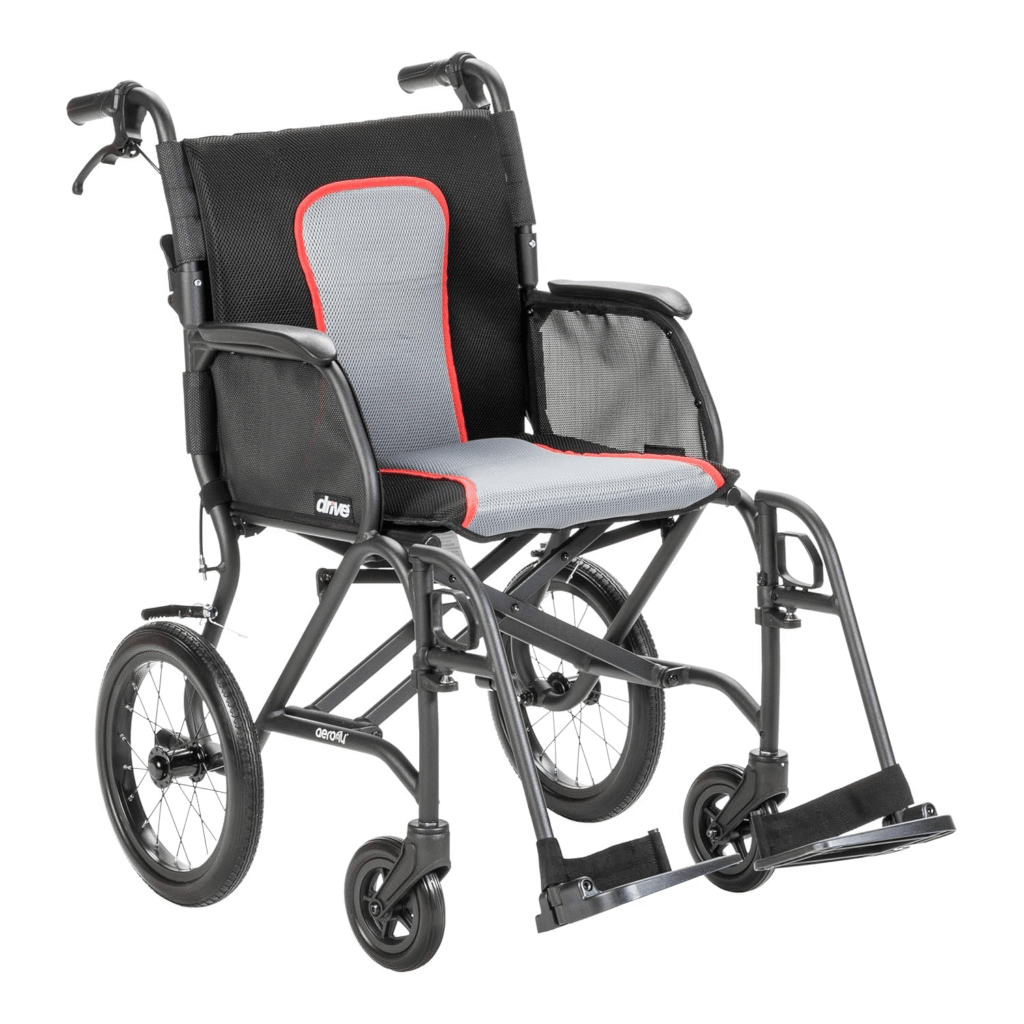
Wheelchair vs. Transport Wheelchair: Side-by-Side Comparison
| Feature | Standard Wheelchair | Transport Wheelchair |
|---|---|---|
| Who moves it | The user, by pushing the handrims | A caregiver or companion |
| Wheel size | Large rear wheels (24″) | Small wheels all around (8″–12″) |
| Weight | Heavier, typically 30–50+ lbs | Lightweight, typically 15–20 lbs |
| Best for | Daily living, extended use | Short trips, occasional outings |
| Portability | Bulkier, harder to lift into a car | Folds compactly, built for trunk storage |
| Who it suits | Users with upper body strength to self-propel | Users who rely on a caregiver for mobility |
Which One Do You Need?
This is where the wheelchair vs. transport wheelchair question stops being about the chair and starts being about the person. The real question isn’t age or diagnosis — it’s function. Can the person reliably push themselves for meaningful distances, day after day? Or is their mobility limited enough, whether from arthritis, a stroke, Parkinson’s, a brain injury, or simply not having the stamina they used to, that they need someone else doing the moving?
A standard wheelchair makes sense when the person will be using it regularly, for real distances, and has the strength and coordination to self-propel — even if that strength is limited, as long as it’s there.
A transport wheelchair makes sense when trips are occasional, distances are short, and there’s a caregiver available to do the pushing every time it’s used. Some households genuinely need both: a standard wheelchair for home and daily use, and a lightweight transport chair that lives in the trunk for appointments and outings.
There’s no wrong answer here — only a mismatch between the chair and how it’ll actually be used, which is the single most common and most avoidable mistake families make.
A Real-World Way to Think About It
Caregivers who’ve been through this transition tend to describe the same moment: the chair that worked fine at home suddenly doesn’t work for the trip to the cardiologist, because it’s too heavy to lift, too bulky to fold, or too much for one person to manage alone in a parking lot.
That’s usually the moment a transport wheelchair earns its place — not as a replacement for the primary chair, but as the practical answer to “how do I get them there without hurting my own back.”


Here’s my dad in his Drive Silver Sport wheelchair, on one of our regular trips to visit my mom. If I ever asked where he wanted to go, the answer was almost always the same — “let’s go see your mom.” It was about a twenty-minute drive, and we’d usually spend ten minutes or so there before heading back.
That wheelchair made those visits possible for years — it did him well for at least four years before the wear and tear caught up with it and it needed repair work. One tip I picked up along the way: call a bike shop, not a medical supply store. The guys who fix bikes know how to fix wheelchair wheels — it’s the same kind of hardware — and they’re usually faster and cheaper than going through a DME supplier.
A Note on Insurance and Medicare Coverage
Medicare and most insurance plans classify both standard and transport wheelchairs as durable medical equipment (DME), but coverage details — required documentation, whether a transport chair qualifies on its own versus needing to be paired with specific mobility limitations — can differ and do change.
Common Mistakes When Choosing Between the Two
The most common mistake in a wheelchair vs. transport wheelchair decision is buying based on price or availability rather than function. A transport chair is usually cheaper and easier to find, which makes it tempting to buy as an all-purpose solution — but if the person needs it for hours of daily use at home, a transport chair’s small wheels and minimal cushioning weren’t built for that job, and it will wear out fast, or worse, become unsafe.
The reverse mistake happens too: buying a full standard wheelchair for a household that only needs it a few times a month for short outings, when a transport chair would have been lighter, cheaper, and far easier for one caregiver to manage alone.
For More Information Follow The Link Below
Choosing the right lightweight wheelchair isn’t just about comfort — it’s about keeping someone as independent as possible for as long as possible. Researchers have found that maintaining mobility and preventing disability are key to living independently as we age, which is exactly why getting this choice right matters so much for daily life. A wheelchair that’s too heavy to load, too hard to maneuver, or too uncomfortable to sit in for long stretches can quietly take away that independence one outing at a time. For more on why mobility preservation matters, the National Institute on Aging has a good overview.
Bottom Line
The wheelchair vs. transport wheelchair decision really comes down to one question: who’s doing the moving? If the answer is “the person themselves, regularly,” a standard wheelchair is the right tool. If the answer is “a caregiver, for occasional trips,” a transport wheelchair is the better fit — lighter, easier to fold, and built for exactly that job. Understanding this difference before you buy saves money, saves your back, and gets the right chair into the right hands the first time.
Frequently Asked Questions
Can a transport wheelchair be self-propelled?
Not typically. Transport wheelchairs use small rear wheels (8–12 inches) without handrims, so they’re built to be pushed by a caregiver or companion, not propelled by the user. If self-propulsion matters, a standard wheelchair’s larger wheels (20–24 inches) with handrims are what to look for.
Is a transport wheelchair the same as a wheelchair?
No. They’re both wheelchairs, but built for different jobs. Transport wheelchairs are lighter, more compact, and easier to fold and lift into a car — ideal for outings and appointments. Standard wheelchairs are built for daily, independent use at home, with larger wheels, more adjustability, and features like removable armrests and swing-away footrests.
Which one does Medicare cover?
Medicare Part B covers both standard and transport wheelchairs as durable medical equipment when medically necessary, paying 80% of the Medicare-approved amount after the Part B deductible ($283 in 2026) — you’re responsible for the remaining 20% coinsurance. Coverage requires a doctor’s written order and a face-to-face exam documenting that you can’t safely get around at home even with a cane or walker. Since every case is different, confirm specifics with Medicare.gov or your DME supplier before buying.
Can one person use both a standard wheelchair and a transport wheelchair?
Yes — it’s actually pretty common. Someone might use a standard wheelchair at home where self-propulsion and daily comfort matter, and keep a lighter transport wheelchair in the car for appointments, shopping trips, or travel where portability counts more than independence. Function needs can shift by setting, not just by day.
Which is better for someone with Parkinson’s or arthritis?
It depends on what function is actually compromised, not the diagnosis itself. If arthritis affects the hands or shoulders, pushing handrims on a standard wheelchair can be painful, so a transport wheelchair someone else pushes may be more comfortable for outings. With Parkinson’s, freezing episodes and fatigue can make longer outings unpredictable, so many families keep a transport wheelchair on hand for those days while the person still walks independently at home the rest of the time. The right call comes down to matching the chair to the specific tasks that have gotten hard, not the label.
Is a standard wheelchair the same as a manual wheelchair?
Yes. Standard, manual, regular, and self-propelled wheelchair all describe the same chair — the one with large rear wheels and handrims that the user pushes themselves. You’ll see all four terms used interchangeably online and in medical supply stores. A transport wheelchair is the different one: smaller wheels, no handrims, built to be pushed by a caregiver instead.
