

If you’ve spent any time researching recovery equipment for a broken ankle, foot surgery, or Achilles injury, you’ve probably run into two terms that seem to describe the same thing: knee scooter vs. knee walker. Here’s the short answer — there isn’t a real difference. They’re the same device, just called by different names depending on the brand, the region, or who’s selling it.
Everything here is rooted in my experience caring for my dad, but this site isn’t just for seniors — it’s for anyone recovering from surgery, managing an injury, or living with a condition that affects mobility, at any age. My dad’s own recovery never involved a knee scooter, since his mobility challenges were different, but I get enough questions about this device through the site that it’s worth a clear, honest answer instead of letting the confusing terminology sit unresolved.

Why Two Names for One Device?
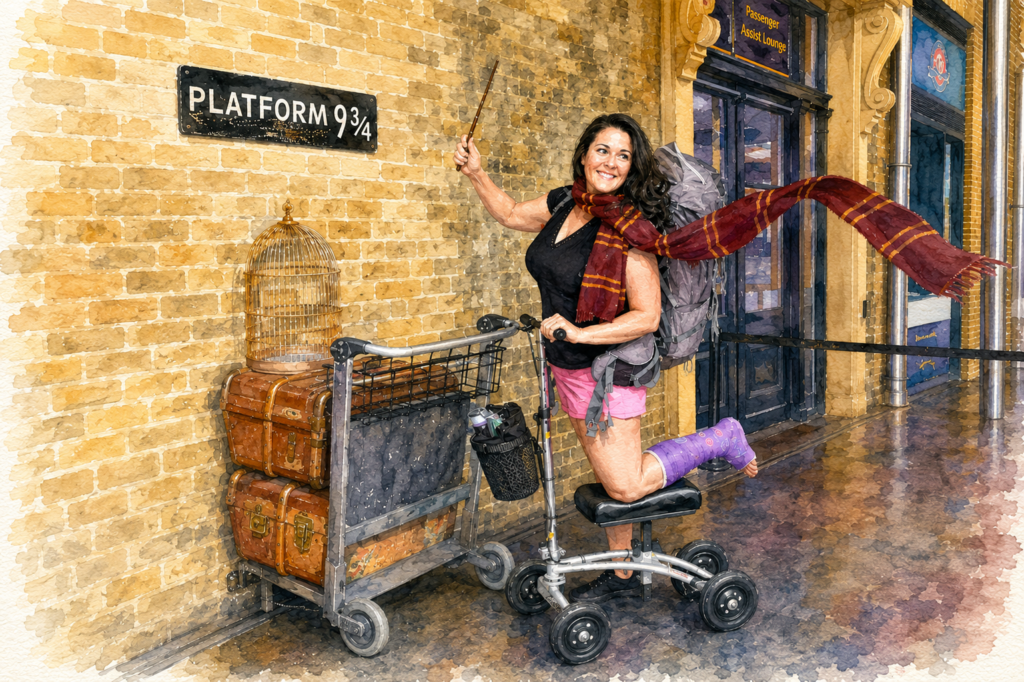
A knee scooter (also called a knee walker) is a wheeled device that lets you rest your injured leg — bent at the knee — on a padded platform while you push yourself along with your good leg. It’s designed as an alternative to crutches for anyone who can’t put weight on one foot or leg, whether that’s from a fracture, ankle surgery, Achilles tear, or a diabetic wound that needs to stay off the ground. Most knee scooters fold down for storage and come in steerable and non-steerable versions, depending on how tight the spaces are that you’ll be navigating.
Some brands and retailers lean toward “knee scooter” because it’s the more widely searched and more immediately understandable term — most people picture something scooter-like right away. Others use “knee walker” to tie it into the broader walker and mobility-aid category. You’ll also see less common variations like knee caddy, knee cruiser, or leg walker, all referring to the exact same type of device.
Most people run into this naming mix-up right after a doctor’s visit — a provider will say “knee scooter” one day and “knee walker” the next while explaining non-weight-bearing recovery after something like an ankle fracture. It’s not two products, just two names for the same instruction.
One important distinction: a knee scooter/walker is not the same as a standard walker or rollator. Those are frames you stand upright in and walk with using both legs. A knee scooter is specifically for non-weight-bearing recovery on one leg — you’re kneeling on the platform with the injured leg, not standing on both feet. If you’ll be using yours outdoors on grass, gravel, or uneven pavement, look specifically for an all-terrain knee scooter with larger air-filled tires rather than the standard indoor casters.
What Actually Varies: 3-Wheel vs. 4-Wheel Models
While “knee scooter” and “knee walker” don’t describe different products, there is a real distinction worth knowing about when you shop — wheel count.
| Feature | 3-Wheel Model | 4-Wheel Model |
|---|---|---|
| Maneuverability | Tighter turns, better indoors | Wider turning radius |
| Stability | Good, slightly less stable | More stable, wider base |
| Best terrain | Indoor, small spaces | Outdoor, uneven ground |
| Weight capacity | Typically 250–300 lbs | Often up to 350+ lbs |
| Storage basket | Sometimes included | Usually included |
Why Choose a Knee Scooter Over Crutches
This is really the more useful comparison for most people weighing their options after an injury. Crutches put all the work on your arms and shoulders, which gets tiring and painful fast, especially over weeks of recovery. A knee scooter lets your leg muscles do the work instead, so you move with less fatigue and less risk of losing your balance and putting weight on the injured leg by accident.
What to Look for When Buying
Whichever term the listing uses, look for the same things: a padded, adjustable knee platform (left- or right-leg compatible if you need flexibility), locking hand brakes, an adjustable handlebar height, and a weight capacity that comfortably exceeds your own. If you’ll be using it outside on uneven pavement or grass, prioritize a 4-wheel model with larger wheels.
Frequently Asked Questions
Is a knee scooter the same as a knee walker?
Yes. They’re the same device with two different common names — there’s no functional difference between them.
Which term should I search for a better selection?
“Knee scooter” tends to return more results and product variety, since it’s the more commonly used term, but searching both will give you the fullest picture.
Are knee scooters covered by Medicare?
Often yes, as durable medical equipment, when prescribed by a doctor following surgery or injury. Coverage details vary by plan.
Can I use a knee scooter outdoors?
Yes, especially 4-wheel models with larger wheels, though you’ll want to go slower on uneven or wet surfaces.
How long do people typically use one?
It depends on the injury and healing timeline, but many people use one for 4–8 weeks during a non-weight-bearing recovery period, as directed by their doctor.
Final Thoughts on Knee Scooter vs. Knee Walker
Whether you call it a knee scooter or a knee walker, you’re looking at the same device — so don’t let the terminology slow down your search. Focus instead on the details that actually affect your recovery: wheel count (three-wheel models are lighter and turn tighter in narrow hallways, while four-wheel models are more stable on uneven ground), weight capacity (check this against your own weight, not just the device’s max — you want margin, not a number that’s cutting it close), and comfort features like a padded knee platform, adjustable steering column height, and a locking hand brake you can actually reach without straining. Get those three right, and the “scooter vs. walker” label stops mattering.
Ron Anderson, Caregiver To My Dad, A WWII Veteran, For 6 Years
