
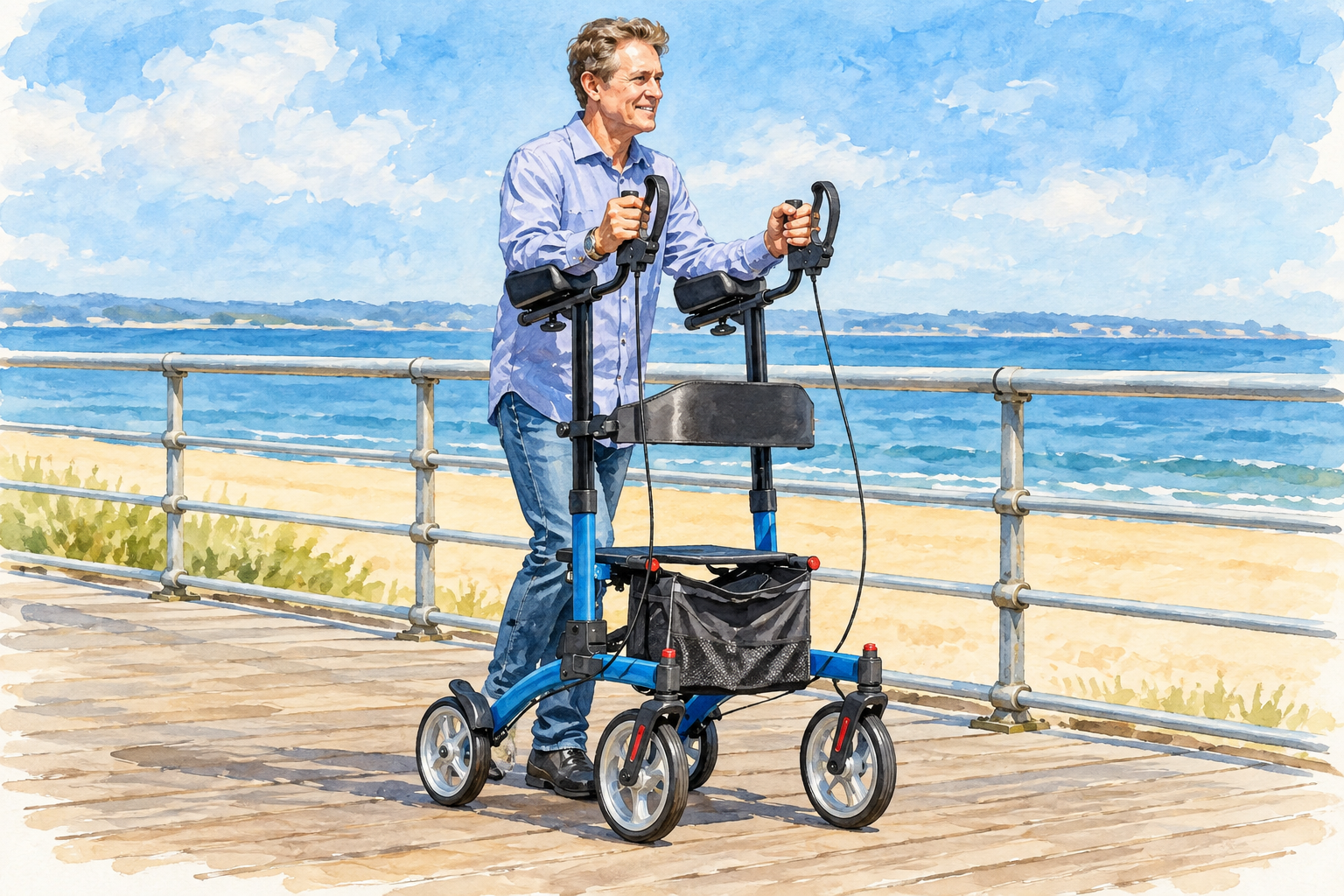
An upright walker is a four-wheel walker with raised forearm rests, so you walk standing tall instead of bent over a set of handles. It usually comes with hand brakes, a seat, and a backrest, much like a rollator, but the frame is built taller. Your weight goes through your forearms instead of your wrists and hands.
You’ll also see them called stand up walkers, upright rollators, or tall walkers. They all mean roughly the same thing. UPWalker is a well-known brand, which is why that name gets used for the whole category, but several companies make them.
My dad used a standard rollator for years, and I learned a lot watching what worked and what didn’t. This guide covers who an upright walker helps, who should skip it, and what to look for if you’re shopping.

What Is an Upright Walker?
On a standard walker or rollator, you hold handles at about hip height and lean slightly forward. Over time, many people end up hunched over the frame, looking at the floor.
An upright walker raises the support to about elbow height. You rest your forearms on padded armrests and hold grips near the front, which is usually where the brake levers are. That keeps your back straighter, your head up, and your eyes forward.
Most upright walkers have:
- Four wheels, often larger than a standard rollator’s, for smoother rolling
- Padded forearm rests that adjust up and down
- Hand brakes you can reach without moving your arms off the rests
- A seat and backrest for resting when you get tired
- A folding frame for storage and car trips
Upright Walker vs. Rollator vs. Platform Walker
| Feature | Standard Rollator | Upright Walker | Platform Walker |
|---|---|---|---|
| Posture | Slight forward lean | Standing tall | Depends on the frame |
| Weight-bearing point | Hands and wrists | Forearms | Forearms |
| Wheels | Three or four | Four | None or two, sometimes four |
| Seat | Usually | Usually | Rarely |
| Weight and size | Moderate | Heavier and bulkier | Bulkier with platforms |
| Best for | General walking, outings, resting | Back strain, hunching, wrist pain, people who want to stand straighter | Hands or wrists that can’t bear weight |
| Typical cost | Lower | Higher | Moderate |
The simplest way to tell them apart: a platform walker is usually a standard walker with forearm platforms added, and it’s built for people who can’t grip. An upright walker is a rolling walker built tall from the start, with brakes and a seat. If you need forearm support plus a place to sit, the upright walker is usually the better fit. If the main problem is the hands, see our guide to Platform Walkers.
Who Is an Upright Walker Good For?
An upright walker can be a good fit for people who:
- Hunch over a standard walker or rollator and end up with back, neck, or shoulder pain
- Have arthritis or pain in the hands and wrists and want to take weight off them without giving up brakes and a seat
- Want to look ahead instead of at the floor, which makes it easier to see obstacles, doorways, and people
- Walk longer distances and need a seat for breaks along the way
- Feel self-conscious about being bent over a walker and want something that feels more natural
My dad had bad arthritis in his hands. He never complained about gripping his rollator, but I bought him built-up-handle utensils because I could see how hard gripping was for him. Looking back, an upright walker might have taken some of that strain off his hands too.

Who Should Think Twice?
An upright walker isn’t right for everyone. It may not be the best choice if the person:
- Has serious balance problems and needs a frame they can lean their full weight into and stop instantly. A standard walker with no wheels, or with two, can be more stable.
- Can’t work hand brakes reliably. Any four-wheel walker can roll away from you. My dad’s hip fracture happened when his rollator got away from him in the hallway, and it changed the rest of his life. If the brakes can’t be managed, four wheels are a real risk.
- Lives in a small home with tight hallways and doorways. Upright walkers are taller and often wider, and they need more room to turn.
- Has to lift it into a car alone. Many models weigh more than a standard rollator.
A physical or occupational therapist can watch the person walk and tell you whether an upright walker, a rollator, or a standard walker is the safest choice.
Features to Look For in an Upright Walker
- Adjustable forearm rest height. The rests should let the elbows sit at roughly a 90-degree angle with the shoulders relaxed, not shrugged up or pushed down.
- Brakes you can reach easily. Try working them the way you’d actually walk, with your forearms on the rests. They should lock in place for sitting.
- A sturdy seat and backrest. Check the seat height so the person’s feet reach the floor when sitting.
- Weight capacity. Check the rating against the person’s actual weight, with some margin.
- Wheel size. Larger wheels roll better over sidewalks, grass, and thresholds. Smaller wheels turn more easily indoors.
- Folded size and weight. Measure your trunk before you buy. If a caregiver will be lifting it, the weight matters.
- Frame width. Measure your narrowest doorway, often the bathroom, and compare it to the walker’s width.
How to Use an Upright Walker Safely
- Get it fitted. Set the forearm rests to the right height before the first walk. A therapist can help, and it only takes a few minutes.
- Lock the brakes before sitting or standing. Every time. This is the most important habit with any four-wheel walker.
- Stay inside the frame. Walk close enough that the forearm rests stay under your arms, and don’t let the walker get out ahead of you.
- Go slowly at first. Walking upright can feel different after years of leaning, so start with short trips on flat ground.
- Take extra care on ramps and curbs. Use the brakes going downhill, and approach curbs straight on, not at an angle.
- Never ride on it. The seat is for sitting while it’s parked and locked, not for being pushed like a wheelchair.
For more on fitting, see our guide on How to Adjust a Walker.
Does Medicare Cover Upright Walkers?
Medicare Part B covers walkers and rollators as durable medical equipment when a doctor documents medical need and you buy from a Medicare-enrolled supplier. Upright walkers are a gray area. Some suppliers bill them as a standard rollator, and Medicare may pay only what it would pay for a basic model, leaving you to cover the difference. Many upright walkers are sold straight to consumers and aren’t billed through Medicare at all.
If coverage matters, ask the supplier before you buy whether they bill Medicare for that specific model and what your share would be. Our guide to Does Medicare Cover Rollator Walkers? walks through the process.
Will Medicare help pay for an upright walker? It might. Medicare Part B treats walkers, including rollators, as durable medical equipment, so if your doctor prescribes one as medically necessary for use at home, you’d typically pay 20% of the approved amount after your deductible. The catch is that you have to go through a supplier enrolled in Medicare, and not every upright model qualifies, so ask before you buy. You can check the details on Medicare’s official walker coverage page. When I was caring for my dad, a quick call to the supplier up front saved us from a surprise bill more than once.

Frequently Asked Questions
What is an upright walker used for?
It helps people walk standing straight instead of hunched over, with their forearms supported instead of leaning on their hands. It’s often used by people with back pain, poor posture, or hand and wrist arthritis.
Is a stand up walker the same as an upright walker?
Yes. Stand up walker, upright walker, upright rollator, and tall walker are different names for the same type of product.
Is an upright walker better than a rollator?
Not always. It’s better for people who hunch over or have wrist pain. A standard rollator is lighter, cheaper, and easier to fit through tight spaces. For a full comparison of walker types, see our guide to walker vs. rollator.
Does an upright walker have a seat?
Most do. Look for one with a backrest and brakes that lock so the walker can’t roll while someone is sitting on it.
Are upright walkers good for seniors?
hey can be, especially for seniors who stoop over a standard walker. But they’re taller, heavier, and roll on four wheels, so they need good brake control and enough room at home to use safely.
Is an upright walker good for arthritis?
Often, yes, especially for arthritis in the hands and wrists, since the forearms carry the weight. Our guide to the Best Walker for Arthritis covers more options.
Final Thoughts
An upright walker won’t fix everything, but for the right person it can make walking feel less like a chore. It lets you stand straighter, see where you’re going, and rest when you need to. The main things to be sure of are that the fit is right, the home has room for it, and whoever uses it can work the brakes every single time.
If you’re not sure whether it’s the right choice, ask a physical therapist to watch the person walk with one before you buy.
This article is based on my experience as a family caregiver and is not medical advice. Talk to your doctor or therapist about which mobility aid is right for you.
