

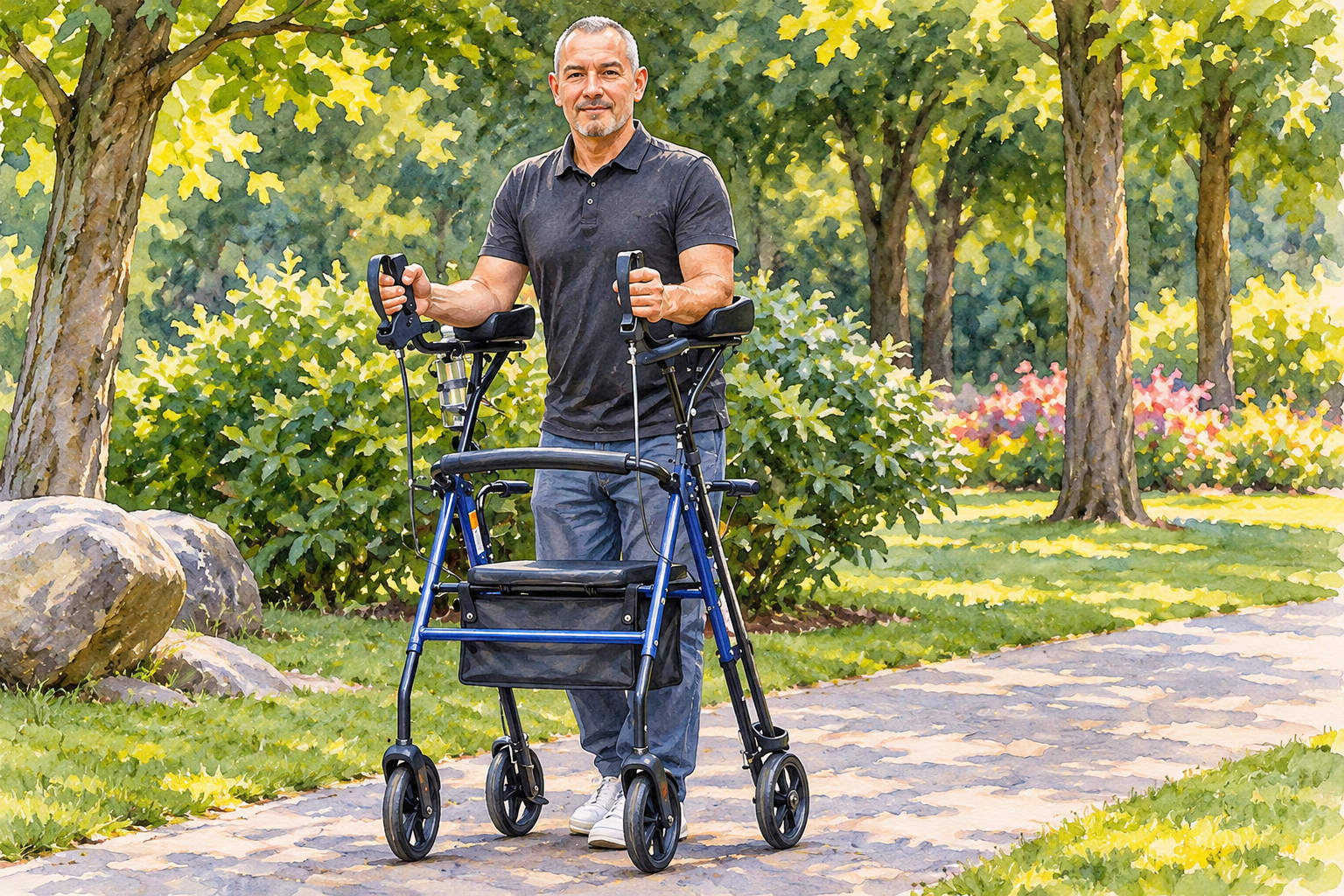
If you’ve ever seen someone at a clinic or rehab center leaning on a walker with their forearms resting in padded trays instead of holding the handles, that was a platform walker. A lot of people search for it without knowing the name. They type things like “walker you lean your forearms on” and get back a confusing mix of answers, because three different names get used for what are really two different things.
This post clears that up: what a platform walker is, who it’s for, the difference between one-side and two-side setups, and how it compares to hemi walkers, standard walkers, and the upright walkers you see advertised online.
My dad had bad arthritis in his hands. His grip was fair, not terrible, but it wasn’t strong anymore, and I think a lot of that was just age. It’s the same reason I got him utensils with the bigger, built-up handles: anything that asked his hands to clamp down hard was going to be a struggle.

What Is a Platform Walker?
A platform walker is a walker where you rest your forearm on a padded trough, or “platform,” instead of gripping the handle with your hand. Your weight goes through your forearm, elbow, and shoulder instead of your wrist and fingers.
In most cases it isn’t a separate walker at all. It’s a standard walker or a two-wheel (front-wheeled) walker with a platform attachment clamped on top of the hand grip. The attachment has a padded forearm tray, a strap to hold your arm in place, and a small upright handle at the front you can rest your hand on or lightly hold.
A platform walker doesn’t change how the walker moves. A standard walker with a platform still gets lifted with each step. A two-wheel walker with a platform still glides forward. The only thing that changes is where your weight goes.
What Is the Walker You Lean Your Forearms On Called?
You’ll see it called any of these:
Platform walker — the most common clinical name, usually meaning a standard or two-wheel walker with a forearm platform attached.
Forearm walker or forearm support walker — the same idea, described by where your arm goes.
Gutter frame — the British and Australian name for a forearm walker.
Upright walker or stand-up walker — this is where it gets confusing. Some medical sites use “upright walker” as another name for a platform walker. Online stores use it for a different product: a tall rollator with four wheels, hand brakes, a seat, and built-in forearm rests, sold mainly for posture.
So if a therapist told you “platform walker,” they almost certainly meant a regular walker with a forearm attachment. If you saw an ad for an “upright walker,” that’s the four-wheel rollator style. More on that difference below.
Who Needs a Platform Walker?
A platform walker is for people who need a walker’s support but can’t safely put weight through their hands or wrists. The usual reasons are:
Arthritis in the hands or wrists. Rheumatoid arthritis and severe osteoarthritis can make gripping a walker handle painful or impossible, especially first thing in the morning.
A wrist, hand, or forearm fracture. If you broke a wrist in the same fall that hurt your hip or leg, you may need a walker for your legs while your arm can’t take weight through the hand. This is one of the most common reasons people end up with a platform.
A weak or non-weight-bearing arm. After hand or wrist surgery, a burn, a tendon injury, or a stroke that left weakness in one hand, a doctor may say “no weight through the hand.” A platform lets the forearm carry the load instead.
Weak grip from neurological conditions. Conditions that affect hand strength or control can make a standard grip unreliable even when the arm itself is strong.
A platform walker is almost always set up by a physical or occupational therapist, and that’s the right way to do it. The height and angle matter more than with a regular walker, and your therapist will tell you how much weight you’re allowed to put on your legs and arms.

One-Side Platform vs. Two-Side Platform
Platforms can go on one side of the walker or both.
A one-side platform is for someone with one injured or weak arm. The bad arm rests on the platform and the good hand grips the regular handle on the other side. This is common after a single wrist or hand fracture.
A two-side platform is for someone who can’t grip with either hand, such as a person with arthritis in both hands or wrists, or injuries to both arms. Both forearms rest on platforms.
Platform attachments are usually sold one at a time, so if you need two, make sure you order two.
Platform Walker vs. Hemi Walker vs. Standard Walker
These three get mixed up because they all help people with one weak side or arm, but they solve different problems.
A standard walker is the basic four-legged frame you lift and set down with each step, holding a handle in each hand. It gives the most stability, but it needs two working hands.
A hemi walker is a one-handed walker. It’s narrower than a standard walker and you hold it with one hand at your side. It’s for people who have one arm that can’t be used at all, often after a stroke. (I compared these in more detail in my hemi walker vs. standard walker vs. quad cane post.)
A platform walker keeps the full two-sided support of a standard walker but lets you lean on one or both forearms instead of your hands. If your arm still works but your hand or wrist can’t take weight, a platform is usually the better fit. If one arm can’t help at all, a hemi walker or quad cane usually is.
If you’d like the clinical view, Physiopedia’s guide to walkers explains how therapists pick between walker types. It includes platform and forearm-support models, and it notes research showing that forearm support can help older adults stand more upright and walk more efficiently than a standard four-wheeled walker. It’s a good read before you talk with your therapist.
Platform Walker vs. Upright Walker: Are They the Same?
Sometimes, depending on who’s using the words. But the products you can buy are different.
A platform walker, in the clinical sense, is a standard or two-wheel walker with forearm platforms added. It’s meant for injury, surgery recovery, or hand and wrist problems. It’s simple, fairly inexpensive, and an attachment can go on a walker you already own.
An upright walker, as sold online, is a tall four-wheel rollator with forearm rests built in, plus hand brakes and usually a seat. It’s mainly sold to help people stand up straighter instead of hunching over a regular walker or rollator. It’s heavier and bulkier, and it needs enough hand strength to work the brakes and enough balance to control a four-wheel frame.
If your problem is your hands or wrists, start by asking your therapist about a platform attachment. If your hands are fine and your main complaint is hunching, back pain, or wanting to walk farther with a seat to rest on, an upright walker may be worth a look.
How to Use a Platform Walker
Your therapist should do the first fitting, but here’s what a correct setup and use look like so you know what to check at home.
Set the height. Stand up straight inside the walker with your shoulders relaxed. Your forearm should rest flat on the pad with your elbow bent at about a right angle. If your shoulders hike up toward your ears, the platform is too high. If you’re bending forward to reach it, it’s too low. This is different from a regular walker, where the handle sits at your wrist crease. (My how to adjust a walker post covers the regular-walker setup.)
Secure your arm. Rest your forearm in the tray and fasten the strap snugly, but not tight enough to cut off circulation. Your hand can rest on the front handle or hold it loosely. Don’t squeeze it if you’ve been told not to bear weight through your hand.
Walking with a standard (no-wheel) frame. Lift the walker by raising your forearms and shoulders, set it down an arm’s length ahead with all four legs touching, then step into it. Lead with your weaker leg, then bring the stronger one through. Some platforms pivot to help you lift. Ask your therapist to set the angle.
Walking with a two-wheel frame. Push the walker forward and step into it the same way. With the wheels it glides instead of being lifted, which is easier on your shoulders.
Standing up and sitting down. Don’t pull up on the platforms to stand. Push up from the arms of the chair, then move your forearms onto the platforms once you’re steady. Reverse that to sit. A walker can tip if you lean on it while standing or sitting.
Stairs. Don’t use a platform walker on stairs unless your therapist has specifically trained you to. (See my post on using a walker on stairs.)
Check it regularly. Make sure the clamp is tight on the walker frame, the pad isn’t torn, and the strap still holds. A platform that slips or rotates while you’re leaning on it can throw you off balance.
Can You Put a Platform on a Walker You Already Have?
Usually, yes. Most platform attachments are sold as universal and clamp over the existing hand grip of a standard adult walker. Before you buy, check:
Weight capacity. Standard attachments are often rated around 300 lb. Heavy-duty or bariatric versions are available.
Fit. Check the clamp against your walker’s frame diameter, and whether you need one attachment or two.
Adjustability. Look for a pad that tilts or slides forward and back, so you can find a comfortable angle.
Rollators are harder. Platforms aren’t designed for them, and with your forearm in a platform you may not be able to reach the hand brakes safely. Talk to your therapist before trying it.

Does Insurance or Medicare Cover a Platform Walker?
Platform walker attachments have their own medical equipment billing code (E0154), so with a prescription they can be billed as durable medical equipment the same way a walker can. Whether your plan pays, and how much, depends on your coverage and the supplier. My posts on Medicare coverage for walkers and getting a prescription for a walker walk through those steps.
Frequently Asked Questions
Is a platform walker the same as a gutter frame?
Yes, close enough. “Gutter frame” is the term used in the UK and Australia for a walker with forearm troughs.
Is a platform walker the same as an upright walker?
Sometimes the names overlap, but the upright walkers sold online are four-wheel rollators with built-in forearm rests, brakes, and a seat. A clinical platform walker is a standard or two-wheel walker with forearm attachments.
Can I use a platform on just one side?
Yes. A one-side platform is common when only one hand, wrist, or arm is injured.
Do I need a prescription?
Not to buy an attachment online, but you’ll usually need one for insurance or Medicare to pay. And since fit matters so much, it’s worth having a therapist set it up either way.
How long will I need a platform walker?
For a fracture or surgery, often only weeks to a few months while the hand or wrist heals. For arthritis or a lasting condition, it may be long term.
Final Thoughts
A platform walker solves one specific problem: when the hands and wrists can’t safely carry the load, the forearms take over. For people living with arthritis, tremor, a stroke, or a wrist injury, that one change can mean walking safely again without relying on a grip that isn’t there anymore. Like any mobility aid, it only works well when it’s fitted correctly, so have a physical or occupational therapist set the platform height before you start using it every day. The right fit is the difference between a device that gets used and one that ends up in the corner.
