
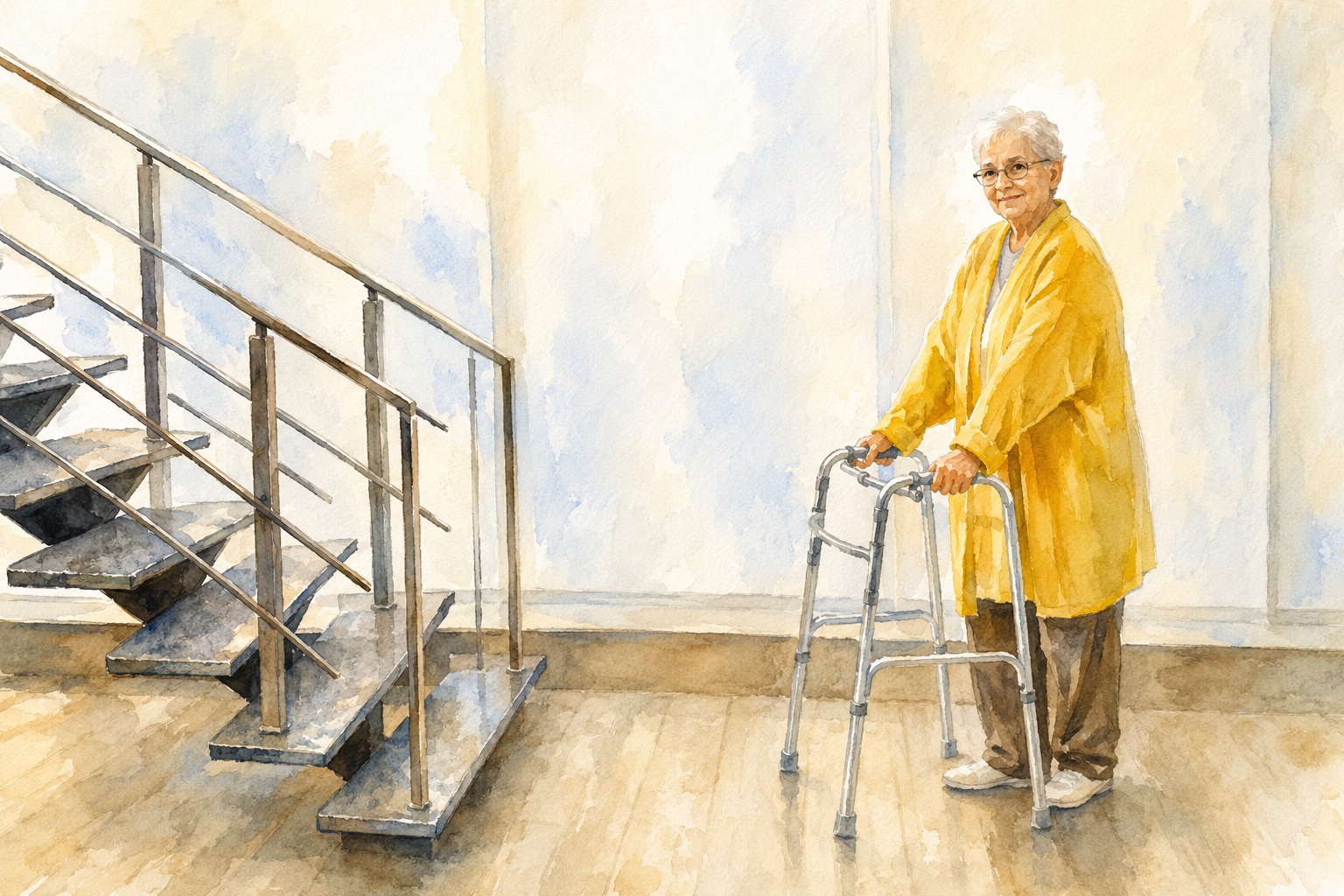
When my dad had his stairlift put in, I thought that would solve the stairs problem completely. It didn’t — not entirely. He still needed to get from the bottom of the stairs to the washing machine, and there was no way I was going to carry a walker down after him every single time. So we kept two: one parked at the top of the stairs, one waiting at the bottom. He’d ride the lift down, transfer onto the walker that was already there, and go do his laundry without either of us wrestling a walker down a flight of steps.
That’s really the heart of learning how to use a walker on stairs: it’s not about muscling through it. It’s about setting things up so you never really have to.
Stairs are one of the most dangerous spots in any home when balance, strength, or mobility is limited. And the honest truth is that most walkers were never designed to be used on stairs at all.
That doesn’t mean you’re out of options. It means you approach stairs with a clear plan — and know when a safer alternative is the smarter move.
In this guide, we’ll cover when a walker near stairs might be workable, when it’s genuinely not safe, and the alternatives — like the two-walker setup that worked for my dad — that let you move around your home with more confidence and a lot less risk.

Can You Use a Walker on Stairs?
In most cases, no — you should not use a walker on stairs.
Walkers are built for flat, stable ground, not steps. Trying to use one on stairs can quickly lead to a loss of balance or a serious fall.
If stairs are part of your daily routine, safer options include using a handrail, getting help from someone else, or avoiding the stairs altogether when you can.
Why Walkers and Stairs Don’t Mix
Let’s be honest — walkers are built for flat, stable surfaces. Stairs work against nearly everything a walker is designed for:
- Uneven height with every step
- No flat surface for all four legs or wheels to sit on
- Higher risk of tipping forward or backward
- Less control if your balance shifts suddenly
Even people with strong, steady balance can struggle on stairs. Add a walker into the mix, and things can go wrong fast.
That’s why most physical therapists will tell you the same thing: avoid using a walker on stairs whenever you possibly can. Being cautious here isn’t overreacting — it’s the right call. What looks like a small stumble on flat ground can turn into a serious injury on a staircase.

When You Should NOT Use a Walker on Stairs
This is the part that really matters.
There are times when using a walker on stairs simply isn’t worth the risk. No workaround, no “I’ll be careful” — it’s not safe, period.
Avoid it completely if:
- Your balance isn’t steady
- You depend heavily on the walker just to stay upright
- There’s no solid handrail you can trust
- The stairs are narrow, steep, or uneven
- You’re recovering from surgery (especially hip or knee)
- You feel unsure, nervous, or hesitant
That last one matters more than people think. If it doesn’t feel safe, it probably isn’t. Don’t try to push through it or figure it out on your own.
A fall on stairs isn’t like a stumble on flat ground — it can go bad fast. This is one of those situations where playing it safe is the right call, no question about it.
Safer Alternatives to Using a Walker on Stairs
Before we even get into technique, let’s talk about better options — because in real life, these are almost always the smarter choice.
1. Use the Handrail Instead
If you’re able to stand and support yourself safely:
- Hold the handrail firmly with one hand
- Take it slow, one step at a time
- Have someone nearby if possible
This gives you far more control than trying to manage a walker on stairs.
Short Video: How to Use a Walker on Stairs
2. Have Someone Assist You
This is one of the safest ways to handle stairs. A caregiver or family member can:
- Help steady your balance
- Carry the walker up or down for you
- Stay close as you take each step
There’s no downside to having help here. It’s just the smart move.
3. Keep a Second Walker on Each Level
This is exactly what worked for my dad. One walker stays at the top of the stairs, one stays at the bottom. You use the stairs on your own — with a handrail or help — and a walker is already waiting for you when you get there.
For him, that meant riding his stairlift down and having a walker parked right at the foot of the stairs so he could get straight to the washing machine, without anyone needing to carry a walker down after him. It’s a simple setup, but it removes the single riskiest part of the whole equation: trying to bring the walker down the stairs with you.
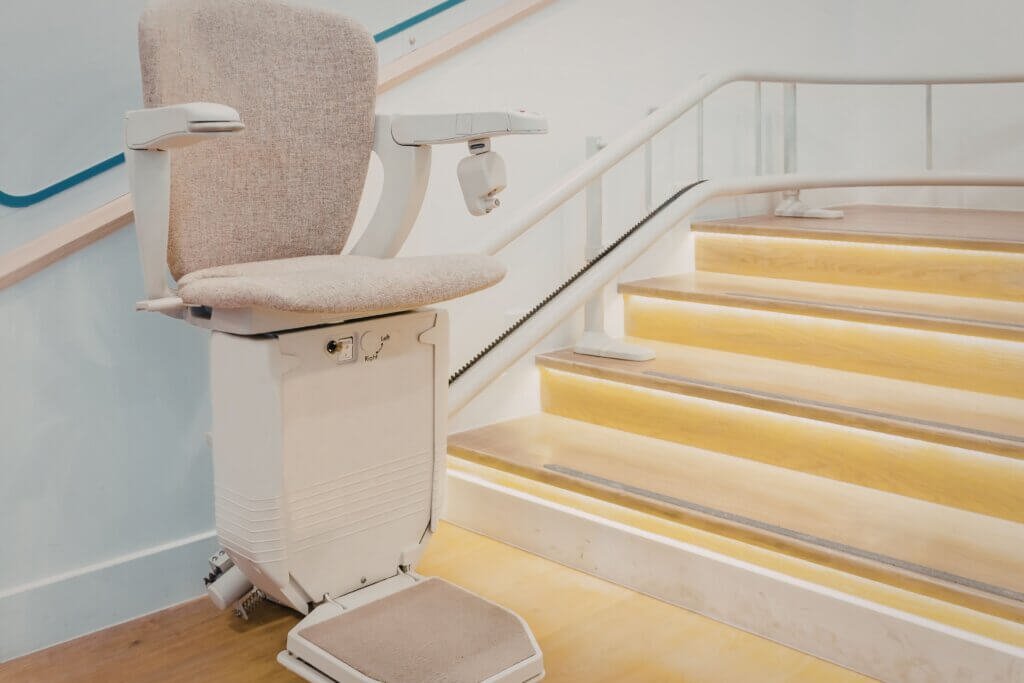
4. Consider a Stairlift
If stairs are part of your daily routine, this is worth serious thought. A stairlift takes the risk out of the equation entirely — no balancing, no carrying, no guessing.
It’s not for everyone, and it’s not a small investment. But for the right household, it can make daily life a whole lot safer — and pairing it with a walker on each level, like we did, solves the “last few feet” problem a stairlift alone doesn’t.
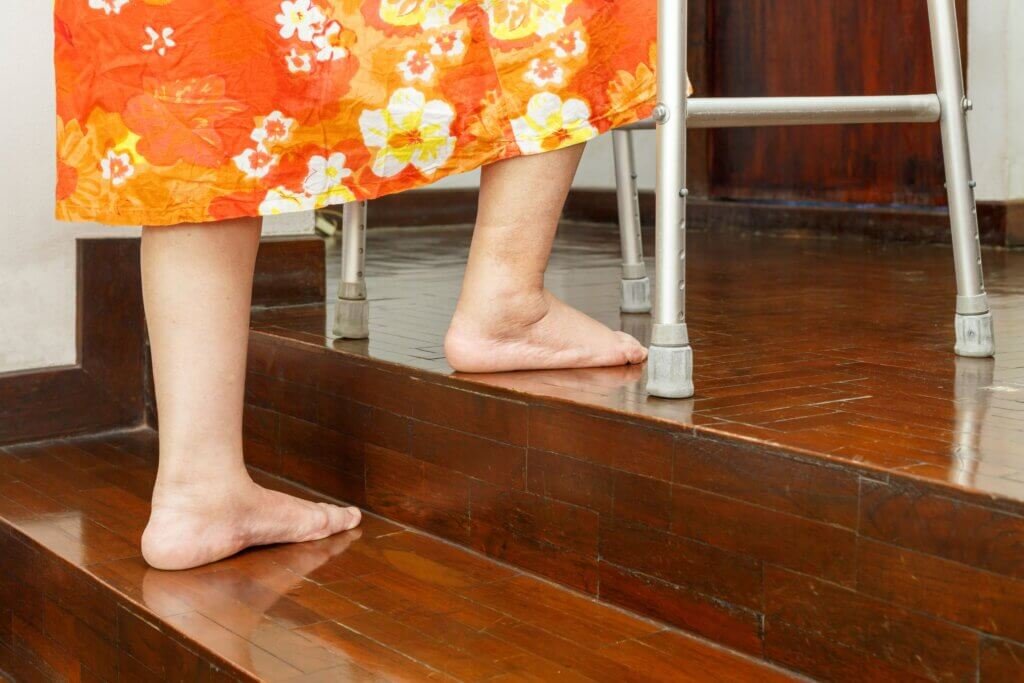
If You Absolutely Must Use a Walker on Stairs
This should only be attempted if there’s genuinely no better option — and ideally after a physical therapist has shown you how to do it safely. If you’re going to attempt it, move slowly and stay in control the entire time.
Going Up the Stairs
- Hold the handrail firmly with one hand
- Carry or position the walker (some people fold it slightly)
- Step up with your stronger leg first
- Bring your weaker leg up to the same step
- Pause, steady yourself, then repeat
Simple way to remember it: “Up with the good.”
Going Down the Stairs
- Hold the handrail securely
- Move the walker down to the next step if you can
- Step down with your weaker leg first
- Bring your stronger leg down to meet it
- Take your time — don’t rush any step
Simple way to remember it: “Down with the bad.”
Safety Tips If You Must Use a Walker on Stairs
If you’re in a situation where you truly have no choice, these tips matter:
- Move slowly. Stairs are not the place to hurry.
- Always use a handrail. No exceptions — if there isn’t one, stop right there.
- Keep your weight centered. Leaning forward or back can throw you off balance fast.
- Wear proper shoes. No socks, no loose slippers.
- Make sure the stairs are well-lit. Shadows can hide the edge of a step.
- Don’t carry anything. Your focus should be entirely on staying steady.
And one more thing that matters just as much: if something feels off, even a little, trust that feeling and stop.

The Reality Most People Don’t Want to Hear
Here’s the honest truth: if you need a walker to move safely on flat ground, stairs probably aren’t something you should be handling on your own.
That’s not a failure — it’s just being realistic about safety.
A lot of people try to push through this stage because they don’t want to lose their independence. That’s understandable. But the right move is the one that keeps you out of the hospital.
Independence doesn’t mean doing everything the hard way. It means doing things the safe way, so you can keep going.
Common Mistakes That Lead to Falls
These are the things that trip people up more often than you’d think:
- Trying to use the walker the same way you would on flat ground
- Skipping the handrail, or not using it consistently
- Moving too fast or getting impatient
- Carrying things while going up or down
- Using the stairs when you’re already tired or unsteady
- Not asking for help when you really need it
Most falls don’t happen because someone didn’t know better. They happen because one small shortcut turns into a bigger problem. Avoid these, and you lower your risk in a real, meaningful way.
When It’s Time to Make a Change
If stairs are starting to feel like a daily challenge, it’s worth stepping back for a minute and asking:
- Is there a safer way to set up the home?
- Can the main living space move to one level?
- Would some simple equipment make things easier?
This isn’t about giving something up. It’s about making life easier, and a lot safer. Small changes now can prevent big problems later — that stairlift-and-two-walkers setup didn’t happen all at once for us either.
Recommended Options to Consider
If stairs are part of your routine, a few practical solutions can make a real difference:
3. Stairlift Systems — A long-term solution that removes the risk entirely for multi-level homes.
Final Thoughts
Learning how to use a walker on stairs really comes down to one thing: knowing your limits and respecting them.
Stairs aren’t forgiving. One wrong move can turn into a serious fall.
If you can avoid using a walker on stairs, do it. If you can get help, take it. If you need to make changes at home — even something as simple as keeping a second walker on each level — it’s worth it.
The goal isn’t just getting up and down the stairs. It’s staying safe, staying confident, and protecting your independence for the long run.
FAQ
Can you safely use a walker on stairs?
Only if you have no other choice, and only with a handrail and a slow, deliberate pace. Step up with your stronger leg first, then bring the weaker leg up to the same step — remembered as “up with the good.” This should only be attempted after someone has shown you how to do it safely.
Should you carry a walker up and down stairs?
In many cases, no — it’s safer to keep a walker on each level instead, the way we did for my dad, so no one has to carry one up or down at all. If that’s not possible, a caregiver carrying the walker while you focus on the handrail is generally safer than managing both at once.
What’s a safer alternative to using a walker on stairs?
A stairlift removes the risk almost entirely for people who deal with stairs daily. Pairing it with a walker kept at the top and bottom of the stairs solves the “last few steps” problem a stairlift alone doesn’t.
