

The best walker for Parkinson’s disease isn’t the same walker that works well for a hip replacement or a general balance problem. Parkinson’s changes the mechanics of walking itself — shuffling steps, sudden freezing mid-stride, a forward lean, and hands that may tremor too much to manage a standard brake lever.
A walker chosen for those specific problems looks different from a generic “best walker” pick. For most people with Parkinson’s, that means either a sturdy four-wheel rollator with reliable locking brakes and a seat, or, for anyone who deals with freezing episodes, a specialized U-shaped stabilizing walker built around that exact symptom.
Below is a breakdown of why standard walkers often fall short for Parkinson’s, which features actually matter, and which models are worth a look.
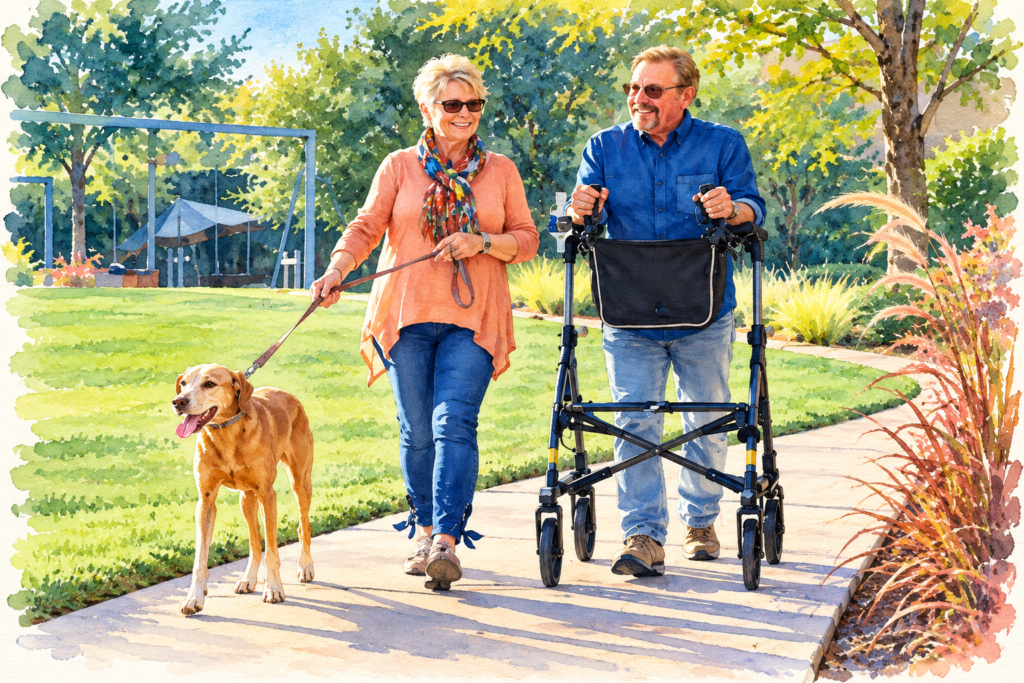
Best walker for Parkinson’s disease
When people ask what the best walker for Parkinson’s disease actually is, it comes down to two categories, depending on which symptom is causing the most trouble day to day
| Walker | Best For | Why It Works |
|---|---|---|
| U-Step 2 Walking Stabilizer Check Price on Amazon |
Freezing episodes, festinating gait | U-shaped frame with no front bar to catch a foot on; reverse-braking system that won’t roll away; optional laser cue line to break a freeze |
| Drive Medical Nitro Rollator Check Price on Amazon |
General mobility, fatigue | Four wheels, locking hand brakes, padded seat for rest breaks, lightweight aluminum frame |
| Medline Freedom Lightweight Rollator Check Price on Amazon |
Smaller-framed or petite users | Lower seat height and narrower width, still with full locking brakes |
| Hugo Mobility Elite Rolling Walker Check Price on Amazon |
Users who want storage plus a seat | Built-in tote bag and cup holder, seat, loop brakes that are easier to grip with tremor |
A standard two-wheel walker or a basic four-legged walker without wheels is rarely the right call here. Both require the user to pick up or push the frame forward in a coordinated motion, which is exactly what a shuffling, festinating gait struggles to do.
Why Parkinson’s Changes What You Need in a Walker
Parkinson’s doesn’t just slow someone down — it changes the pattern of walking. Three symptoms in particular matter for choosing equipment:
- Festination: rapid, shuffling steps that seem to chase the body’s center of gravity, often speeding up involuntarily
- Freezing of gait: a sudden, temporary inability to take the next step, often at doorways, turns, or when starting to walk
- Forward-leaning posture: a stooped stance that shifts weight ahead of the feet, increasing fall risk with any walker that can roll away too easily
A walker designed for arthritis or general fatigue doesn’t account for any of that. It assumes a steady, predictable stride, which isn’t what Parkinson’s produces.
Features That Matter Most
A few features separate a walker that actually helps from one that ends up in the garage after a month:
- Locking or reverse brakes — Standard push-down brakes on a rollator can roll away if grip strength or timing is off during a freeze. Reverse-braking systems (like the U-Step’s) only allow forward motion when the handles are squeezed, which prevents runaway rolling.
- A frame with no front crossbar — Standard walkers have a bar at foot level that’s easy to catch a shuffling foot on. U-shaped frames eliminate that trip point entirely.
- Wide, stable base — Helps counter the forward lean without tipping.
- Easy-grip handles — Loop or vertical grips are easier to manage with tremor than small round grips that require precise finger pressure.
- A seat — Parkinson’s fatigue can hit suddenly; having a place to sit without needing to find a chair matters more than it seems like it would.
- Visual or auditory cueing — Some models include a laser line projected onto the floor or a metronome-style cue, both of which are documented to help interrupt freezing episodes by giving the brain a target to step toward.
When a Standard Walker Isn’t Enough
If freezing episodes are frequent, a standard rollator — even a good one — often isn’t enough on its own. This is where the U-Step and similar stabilizers earn their higher price tag. The reverse-brake system means the walker physically cannot roll forward unless the user is actively squeezing the handles, which removes the runaway-walker risk that makes freezing so dangerous. The laser cue line, while not necessary for everyone, gives many people a visual step target that breaks the freeze faster than trying to will the legs to move.
For people whose main issue is fatigue, balance, or general unsteadiness rather than freezing, a well-built four-wheel rollator with a seat is usually enough, and considerably less expensive.
Cost and Medicare Coverage
Standard rollators typically run $80–$200. Specialized stabilizers like the U-Step run considerably higher, often $500–$700, because of the reverse-braking mechanism and added engineering. Medicare Part B may cover a walker as durable medical equipment with a doctor’s prescription documenting medical necessity, though coverage for specialized stabilizers can require additional documentation of freezing episodes specifically. It’s worth asking a neurologist or physical therapist to write the prescription with Parkinson’s-specific language rather than a generic “mobility assistance” note.
FAQ
Can someone with Parkinson’s use a regular rollator?
Often yes, especially in earlier stages before freezing becomes frequent. A standard four-wheel rollator with locking brakes and a seat works well for general mobility and fatigue.
What makes the U-Step different from a normal walker?
Its reverse-braking system only lets the walker roll when the handles are squeezed, and its U-shaped frame removes the front bar that a shuffling foot could catch on — both aimed directly at Parkinson’s-specific fall risks.
Do laser or cueing walkers actually help with freezing?
Many users and physical therapists report they do, since visual cues give the brain a concrete target to step toward, which can interrupt a freeze faster than trying to consciously restart walking.
Is a cane ever enough instead of a walker?
In very early stages, sometimes. But canes require more balance and coordination than most walkers, and they don’t address freezing at all, so most people transition to a rollator or stabilizer as symptoms progress.
For More Information:
The National Institute of Neurological Disorders and Stroke (NINDS), part of the National Institutes of Health, explains that people with Parkinson’s often develop a stooped, forward-leaning walk with small, shuffling steps. Some find their legs won’t start moving, as if frozen in place, while others find each step getting faster until they can’t stop. That’s why the right walker matters so much. For a full overview of Parkinson’s symptoms and treatment options, including physical therapy, see the NINDS guide to Parkinson’s disease.
Bottom Line
There isn’t a single best walker for Parkinson’s disease that fits everyone — it depends on which symptoms are causing the most trouble. A solid four-wheel rollator with a seat and reliable brakes handles general mobility and fatigue well. For anyone dealing with freezing episodes, a U-shaped stabilizer with reverse braking is worth the higher cost, because it’s built around the exact failure point that makes freezing dangerous. Talk through the specific symptoms with a physical therapist before buying — they’ll often have tried several models with other Parkinson’s patients and can point toward what’s worked.
