
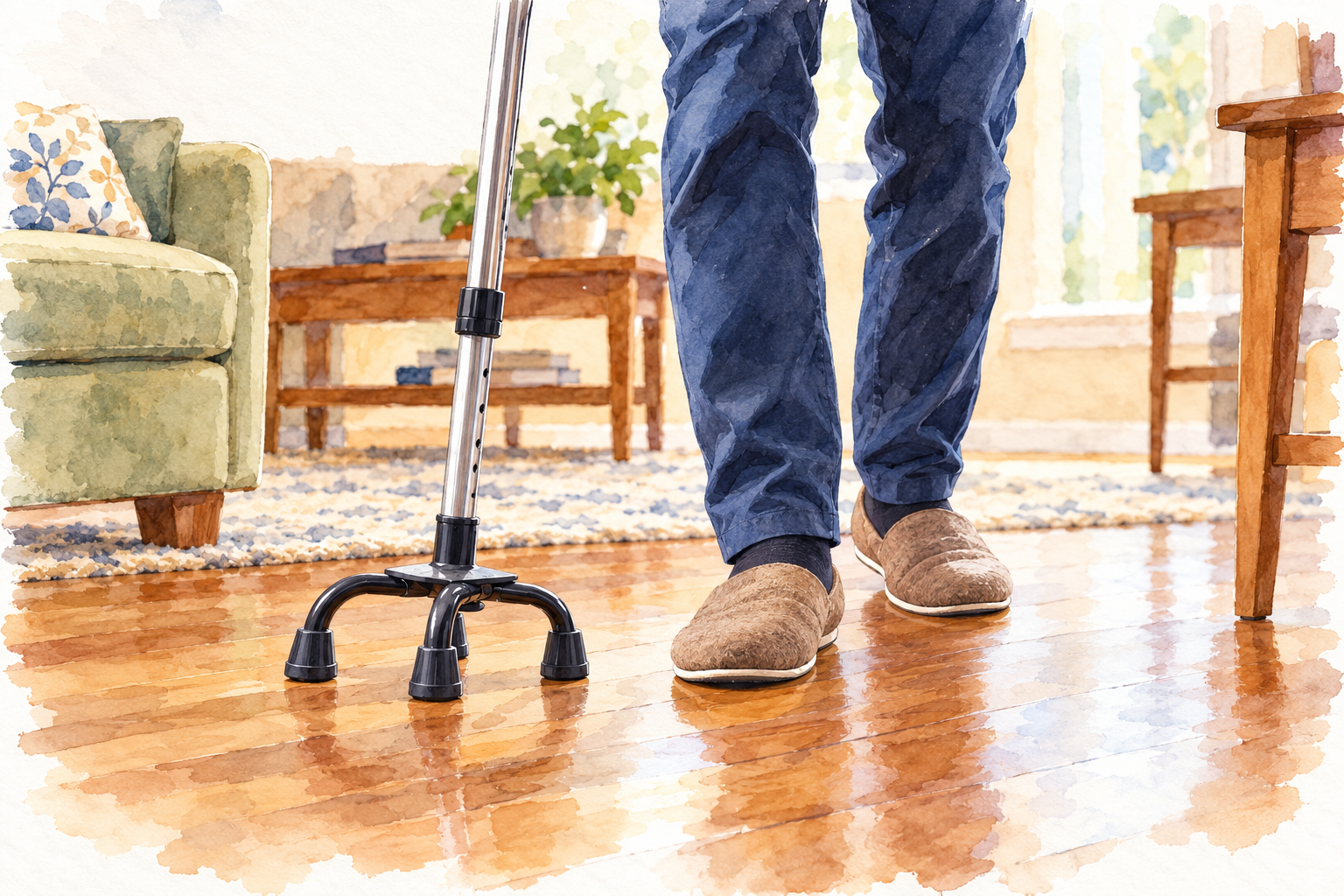
A quad cane is the sturdiest cane you can buy, and it’s the one people reach for when a regular cane starts to feel shaky. My dad never used one. He went from his blue and purple offset canes straight to a rollator, and I’ll explain why later in this guide, because it tells you a lot about who a quad cane is really for.
Nobody ever suggested a quad cane to him, as far as I know. He just bought a cane at the store one day and started using it. My dad was a wise man, a lot smarter than people gave him credit for, and he knew what he needed at the time.
If a physical therapist just handed you one, or you’re wondering whether you need one, this guide Types of Quad Canes covers the different kinds, how to use one safely, and what to look for when you buy.
Quick answer:
A quad cane, also called a quadruple cane or 4 prong cane, is a walking cane with four short legs on a small base. The base gives more stability than a single-tip cane and lets the cane stand up on its own. It works best for people with weakness on one side of the body, such as after a stroke or with a bad hip or knee.

Types of Quad Canes: Small Base vs. Large Base
All quad canes have the same basic design: one shaft, four rubber-tipped feet. The big difference is the size of the base.
- Small-base quad cane: the base is about the size of your hand. It’s lighter and easier to move, fits on most stair treads, and works well for someone who needs a bit more than a regular cane.
- Large-base quad cane: the base is wider and longer, almost like a tiny walker. It’s the most stable cane you can get, but it’s heavier and harder to use on stairs.
You’ll see a few other names out there for canes with a wide base:
- 4 prong cane, four legged cane, four-point cane, quadruple cane: these all mean a quad cane.
- Tripod cane (3 prong cane): three feet instead of four. It still stands on its own, but it gives a bit less support than a true quad.
Most quad canes have an offset handle, the same bend my dad’s canes had, so your weight goes straight down into the base.
Want to see how quad canes fit in with the other options? Read Types of Canes.
Who Needs a Quad Cane (and Who Doesn’t)
A quad cane is a good fit for:
- People with weakness on one side of the body, such as after a stroke
- Someone recovering from hip or knee surgery who has moved past a walker but isn’t ready for a regular cane
- People with arthritis in one hip or knee who lean on their cane a lot
- Anyone who keeps dropping their cane and has trouble bending down for it, since a quad cane stands on its own
A quad cane is probably not the right fit for:
- People with weakness in both legs. A cane, even a quad cane, only supports one side.
- People who need to lean their full weight on something to stay upright
- Someone who walks fast or on rough ground a lot, since all four feet need to sit flat to work
That first “not” is my dad. Both of his legs were weak, so a sturdier cane in one hand wasn’t going to fix the problem. What he needed was support on both sides, and that’s what the rollator gave him. If you’re in the same spot, take a look at Walker vs. Cane before you buy a quad cane.

How to Use a Quad Cane
Using a quad cane is a lot like using a regular cane, with one extra thing to get right: which way the base faces.
- Hold it on your strong side. The cane goes in the hand opposite your weaker or injured leg.
- Point the long legs away from you. One side of the base sticks out farther than the other. Those legs should face away from your body, so you don’t trip on them. If they’re on the wrong side, press the spring button, turn the base around, and make sure the button clicks all the way back through the hole.
- Move the cane and your weak leg together. Set the cane down a short step ahead, with all four feet flat on the floor, then step forward with your weak leg. Bring your strong leg through. Keep your elbow close to your body and take even steps.
- Go slow at first. It takes a few days to get the rhythm.
Going up stairs: stand close to the step. Step up with your strong leg first, then bring the cane and your weak leg up together. Use the handrail with your other hand if there is one.
Going down stairs: put the cane and your weak leg down first, then bring your strong leg down to the same step. A handy way to remember it: up with the good, down with the bad.
A large-base quad cane may not fit on a narrow stair. If it doesn’t sit flat, don’t use it there. Ask a physical therapist about the safest way to handle your stairs.
For the basics that apply to every cane, see How to Use a Cane Correctly.
How to Size a Quad Cane
A quad cane is sized the same way as any other cane.
- Put on the shoes you usually wear.
- Stand up straight with your arms hanging loose at your sides.
- The top of the handle should line up with the crease of your wrist.
- When you hold it, your elbow should bend just a little.
Most quad canes adjust with a push-button. After you change the height, check that the button pops all the way through the hole and the collar is tight before you put weight on it.
What to Look for When Buying a Quad Cane
- Base size: small base for everyday walking and stairs, large base for the most stability.
- Handle: an offset handle with a foam or ergonomic grip is easiest on the hands.
- Weight rating: check the label. Most standard quad canes hold around 250 to 300 pounds, and heavy-duty models hold more.
- Adjustable height: a push-button shaft lets you get the fit right and share the cane if needed.
- Reversible base: lets you switch hands without buying a new cane.
- Replaceable tips: the rubber feet wear out, so make sure replacements are easy to find.
Quad Cane vs. Regular Cane vs. Hemi-Walker

Final Thoughts
A quad cane is a great tool for the right person. If one side is weaker than the other and a regular cane feels wobbly, it can give you back a lot of confidence. And not having to bend down for a dropped cane is a bigger deal than it sounds.
But it isn’t a fix for everything. My dad needed support on both sides, and no cane was going to give him that. If you’re not sure which camp you fall into, a physical therapist can tell you in one visit. It’s worth the trip.
FAQ
What is a quad cane?
A quad cane is a walking cane with four short legs on a small base at the bottom. It gives more stability than a single-tip cane and stands up by itself.
How many tips does a quad cane base have?
Four. Each leg has its own rubber tip, which is where the name “quad” comes from.
Which hand do you hold a quad cane in?
The hand opposite your weaker or injured leg. The cane and your weaker leg move forward together.
Which way should the base face?
The legs that stick out farther should point away from your body, so you don’t trip on them.
What’s the difference between a quad cane and a regular cane?
A regular cane has one tip. A quad cane has four feet on a base, so it’s steadier and stands on its own, but it’s heavier and slower to move.
What is the best quad cane for stability?
A large-base quad cane gives the most stability. A small-base quad cane is easier to carry and handle on stairs.
Can you use a quad cane on stairs?
A small-base quad cane usually fits on a stair. A large base often doesn’t sit flat, which isn’t safe. Use the handrail, and ask a physical therapist if you’re unsure.
Does Medicare cover quad canes?
Yes. Medicare Part B covers canes, including quad canes, as durable medical equipment when a doctor prescribes one. You pay 20% of the approved amount after the deductible.
