
The Clamp That Gave Out
The first thing that failed in my dad’s bathroom wasn’t him. It was a toilet seat.
It was one of those high-rise seats that clamps onto your existing toilet — no tools, no installation, just squeeze it on and go. It seemed fine for a while. Then the clamp started to loosen. I tried gluing it down once, figuring that would buy us some time. It didn’t. One afternoon it gave out from under him, and he ended up on the floor.
He wasn’t hurt badly, but it scared both of us. And it taught me something I hadn’t thought about before that day: a “bathroom safety product” that isn’t installed right isn’t actually safety. It’s just a false sense of one.
I ordered a real toilet safety rail that afternoon. It took three days to arrive, and for those three days I went into the bathroom with him every single time, just to make sure it didn’t happen again. When the rail finally came, it changed things. It bolted to the toilet base instead of clamping onto the seat, with handles on either side like the arms of a chair. He could push himself up on his own again. I ended up duct-taping the old clamp-on seat to the rail’s legs for extra height and stability — a fix nobody sells you, but it held for years.
That’s really what this page is about. Not a list of products, but which ones actually hold up when someone leans their full weight on them — because in a bathroom, that’s the moment that matters.
Full story of my dad’s mobility progression is in Daily Living Aids for Independence — this page goes deeper on the bathroom specifically.
Why the Bathroom Is Different From Every Other Room
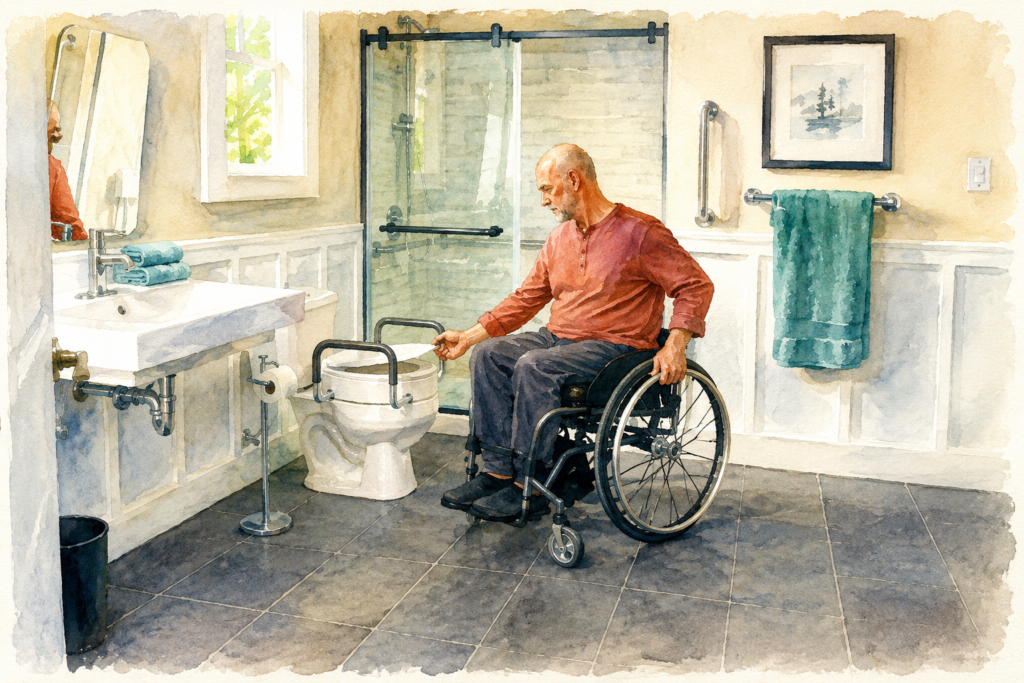
Every room in a house asks something of your balance. The bathroom asks for more than most, all at once: wet, hard surfaces; a tight footprint; and at least two moments — sitting down and standing back up — where your full weight shifts onto legs that may not be as steady as they used to be.
Here’s the number that stopped me the first time I saw it: an estimated 80% of falls that happen at home take place in the bathroom. Not the stairs. Not the kitchen. The bathroom. If you’re caring for someone and you can only really focus your time, money, and attention on getting one room right, this is the room.
That’s not a reason to be afraid of it. It’s a reason to fix the specific things that make it risky, instead of hoping for the best.
Where the Money Is Well Spent
I’m not going to tell you bathroom safety aids are free, because they’re not. But of every room in the house, this is the one where the investment is worth it, without question. A real grab bar, a toilet safety rail, a shower chair, a non-slip mat that actually grips — none of it is free, and all of it is worth it. Compare that cost to what a fall actually costs, in dollars and in everything else, and it isn’t close. You don’t need to remodel. You need the right handful of things, installed correctly, in the spots where people are actually at risk.
Getting In and Out of the Shower Safely
This was the second thing we had to solve, after the toilet.
We put in a floor-to-ceiling security pole in the shower, with a rotating handle my dad could hold onto as he turned himself in. A shower chair sat inside so he could lower himself down once he was in, instead of standing the whole time. We added a wall-mounted grab bar too — not a towel bar, an actual grab bar rated to hold real weight. Towel bars aren’t built for it and will pull straight out of the wall the moment someone leans on one.
For a long stretch, that setup let him do the entire routine on his own: wheel in, grab the pole, stand, turn, sit on the chair, shower, then reverse it all to get back out. He didn’t need me for any of it. That’s what the right equipment, installed properly, actually buys you — not just safety, but independence.
What to look for:
- A grab bar rated for real weight-bearing use, anchored into a stud or with proper wall anchors — not a suction-cup or adhesive bar
- A shower chair with non-slip feet, sized for the actual shower or tub
- If balance is a real concern, a floor-to-ceiling pole gives something to hold the entire time you’re moving, not just at one point
The Toilet Area: Where the Failure Actually Happened
This is the one I’d tell you to fix first, because it’s the one that failed on us.
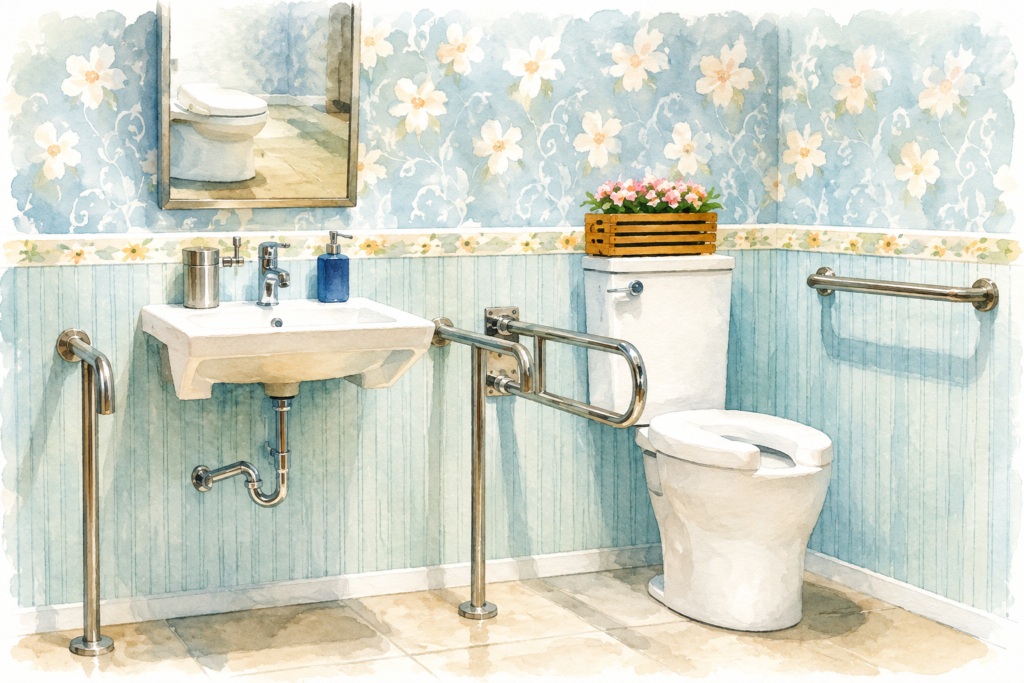
A clamp-on high-rise seat can be a fine short-term fix, but don’t treat it as permanent. If someone is using one daily, or their balance is declining, upgrade to a toilet safety rail that bolts to the toilet base — the kind with two solid arms to push up from. It costs more and takes a little longer to arrive than a clamp-on, but it doesn’t move underneath you.
What to look for:
- A rail or frame that bolts or clamps to the base of the toilet, not just the seat
- Handles positioned so you can push straight up with both arms, not reach awkwardly to one side
- Enough clearance that it doesn’t crowd the space you actually need to sit and stand
Slips, Dry Floors, and the Small Stuff
Most of the rest of bathroom safety isn’t dramatic. It’s habit.
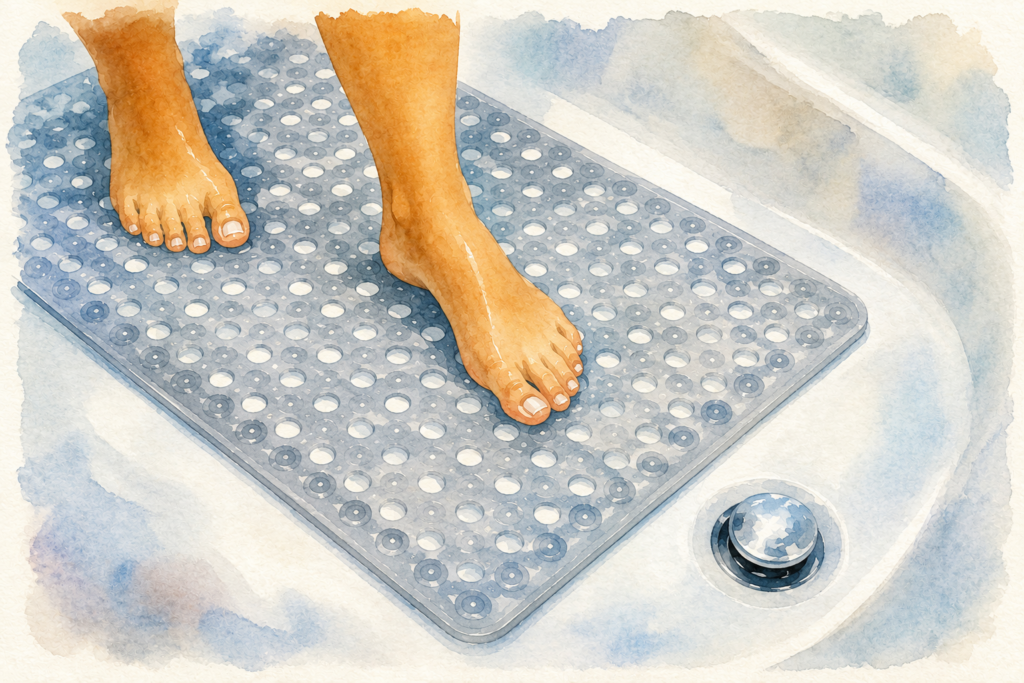
- Non-slip mats, inside the tub or shower and on the floor outside it. Cheap ones slide. Spend the extra few dollars on ones with real grip on the underside.
- Dry the floor immediately. A towel within reach makes this an easy habit instead of a chore you skip.
- Real footwear, even at home. Bare feet slip more than people expect on wet tile. A simple pair of non-slip house shoes solves this.
- Everything within arm’s reach — soap, shampoo, a towel — so nobody has to twist, bend, or lean to grab something mid-shower.
None of this is expensive. All of it matters.
Lighting: Don’t Make Someone Guess Where the Floor Is
My dad’s night vision wasn’t what it used to be, and a dark bathroom at 2 a.m. is a bad place to find out exactly how much it’s changed. Bright, even lighting and a simple night light near the toilet remove one more variable from a moment that’s already asking a lot of someone’s balance.
Quick Reference: Bathroom Safety Aids
| Aid | Solves | Watch For |
|---|---|---|
| Toilet Safety Rail | Sitting/standing support | Bolts to base, not a clamp-on seat |
| Wall-Mounted Grab Bar | Stable handhold in shower/tub | Anchored to a stud, not a towel bar |
| Shower Chair | Sitting instead of standing to wash | Non-slip feet, correct size for the space |
| Non-Slip Bath Mat | Traction in and out of the tub | Strong suction grip underneath, not a flat rubber sheet |
| Handheld Shower Head | Showering while seated | Long enough hose to reach fully while seated |
| Raised Toilet Seat | Easier to stand up | The front Clamp |
When Small Fixes Aren’t Enough
Sometimes a rail and a mat aren’t the ceiling — they’re the floor. If you’re seeing repeated close calls despite the small fixes, it may be time to think bigger: a walk-in shower instead of a tub, a wider footprint to move in, more permanent fixtures built into the room itself.
One thing people don’t think to check until it’s too late: if a wheelchair is in the picture, or might be soon, measure the actual doorway. Standard interior doors run narrower than most manual and power wheelchairs need, and it’s a hard thing to discover the day someone actually needs to get through it. If the door’s too narrow, a smaller or narrower-frame wheelchair for indoor use is usually a more realistic fix than widening a doorway.
None of this is about giving anything up. It’s about making the room work for the person using it, instead of asking the person to keep working around the room.
Final Thoughts
We didn’t get the bathroom right on the first try. The clamp-on seat felt like a reasonable solution right up until it wasn’t, and it took a fall to show us the difference between something that looks like safety and something that actually holds. Every fix after that — the rail, the pole, the chair, the mats — came from paying attention to what had actually failed, not just what looked good on a shelf.
If you’re setting up a bathroom for someone you’re caring for, or for yourself, start with whatever the highest-risk moment actually is in that specific room. For us, it was standing up from the toilet. For you, it might be stepping over the tub edge, or the walk from the bed to the bathroom in the dark. Fix that one first.
FAQ’s
What’s the single most important bathroom safety upgrade?
A properly anchored grab bar or toilet safety rail — something rated to hold real weight, installed into a stud or bolted to the fixture, not a suction-cup or clamp-on product.
Are clamp-on toilet seats safe?
They can work as a short-term or occasional-use solution, but the clamp mechanism can loosen over time, especially with daily use. If someone relies on one every day, a rail that bolts to the toilet base is more reliable.
Do grab bars need to be professionally installed?
They don’t have to be, but they do need to go into a wall stud or use anchors rated for the wall type and the weight involved. A towel bar or a bar mounted only into drywall is not safe to lean on.